
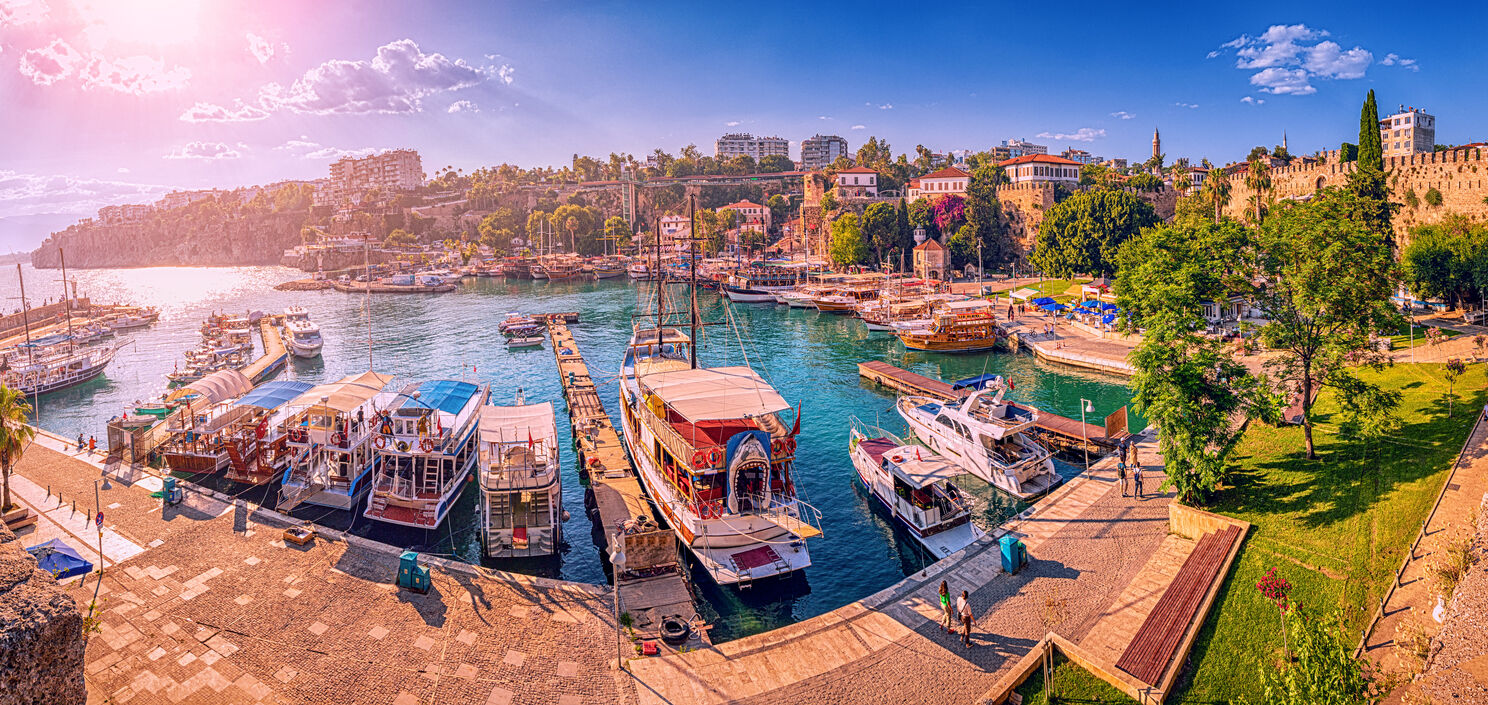
Turkish Riviera
Weather
Local Information
Plug Socket Type
Type C/F (European two-pin). Irish visitors need a travel adapter.
Currency
Turkish Lira (TRY). Euros widely accepted in resorts. Excellent exchange rate means outstanding value for Irish visitors.
Time Zones
GMT+3 (3 hours ahead of Ireland in winter, 2 hours in summer).
Local Emergency Contact
112 (general emergency). 155 (police). Irish Embassy Ankara: +90 312 459 1000.
Travel Information
Flight Time
Approximately 4.5 hours from Dublin to Antalya (AYT) or Dalaman (DLM). Seasonal flights May-October.
Distance from Beach
All Turkish Riviera resorts are beachfront or very close to beaches.
Do I need a Visa?
Irish citizens can get an e-Visa online before travel (approximately €30). Apply at evisa.gov.tr. Valid passport required with at least 6 months remaining.
3 Things to do in Turkish Riviera
Pamukkale
–Stunning white travertine terraces and ancient Roman city of Hierapolis — a UNESCO World Heritage Site.
Ephesus
–One of the best-preserved ancient cities in the world, with the Library of Celsus and Great Theatre.
Boat Trips
–Turkish Riviera is famous for blue cruises along the turquoise coast, visiting hidden bays and islands.
Description
Discover the Turkish Riviera, or Turquoise Coast, a stunning stretch of coastline famed for its beautiful beaches, ancient ruins, 'Blue Cruise' gulet adventures, and vibrant resorts like Antalya, Bodrum, and Marmaris.
The Turkish Riviera encompasses the stunning stretch of Mediterranean and Aegean coastline that has made Turkey one of the fastest-growing holiday destinations for Irish travellers. The region's main resort areas each have a distinct character: Antalya combines a beautifully preserved old town with dramatic waterfalls and a modern marina; Alanya offers a castle-topped peninsula, the famous Cleopatra Beach and a lively international atmosphere; Bodrum blends whitewashed Aegean charm with cosmopolitan nightlife around its ancient harbour; Marmaris sits in a spectacular bay surrounded by pine-clad mountains; and Fethiye provides the gateway to the breathtaking Blue Lagoon at Ölüdeniz. The coast is dotted with ancient ruins — Lycian tombs carved into cliff faces, Roman theatres still hosting performances, and the sunken city of Kekova visible through crystal-clear water. Water sports, boat trips and paragliding are widely available, while the interior offers opportunities for rafting, jeep safaris and visits to traditional mountain villages. The region's all-inclusive resorts are among the best in the Mediterranean, offering exceptional facilities and service at prices that represent outstanding value. Turkish hospitality is genuinely warm, and most resort areas are well set up for English-speaking visitors.
Culture and Experiences
What's Nearby?
Antalya Old Town (Kaleici)
– Beautiful walled old town with Ottoman houses, Roman harbour, shops and restaurants.
Cappadocia
– Fairy chimneys, cave hotels and hot air balloon rides — internal flights available for an unforgettable 2-day trip.
Greek Islands
– Ferry services to Rhodes from Marmaris and to Kos from Bodrum — easy day trips.
History
Ancient Civilisations
– The Turkish coast was home to Lycian, Greek and Roman civilisations.
Ottoman Empire
– The Ottoman legacy is visible in architecture, cuisine and culture.
Gallipoli
– The WWI Gallipoli campaign is of deep significance.
Local Markets
Grand Bazaar Culture
– Every Turkish town has a weekly market for spices, leather, textiles.
Spice Markets
– Dried fruits, nuts, Turkish delight, saffron and exotic spices at excellent prices.
Events and Festivals
Ramadan & Eid
– Dates vary annually. Eid celebrations are lively and welcoming.
Antalya Film Festival (October)
– International film festival bringing culture to the coast.
Oil Wrestling (June)
– Traditional Turkish oil wrestling — a unique cultural experience.
Local Etiquette
Mosque Visits
– Remove shoes, cover shoulders and legs. Free scarves usually provided.
Bargaining
– Expected in bazaars and markets. Not appropriate in restaurants.
Tipping
– 10% in restaurants is standard.
Dining and Night Life
Local Cuisine
Kebabs
– Far beyond the takeaway version — Turkish kebabs include dozens of regional varieties.
Meze
– Shared starter platters of dips, salads and small dishes.
Turkish Breakfast
– Elaborate spread of cheese, olives, tomatoes, cucumber, eggs, honey, bread and tea.
Baklava & Turkish Delight
– Sweet pastries and confections that are genuinely better in Turkey.
Night Life
Alanya
– Castle-area rooftop bars and harbour clubs with a lively atmosphere.
Marmaris Bar Street
– Famous party strip with dozens of bars and clubs.
Fethiye
– More relaxed harbour-side bars and restaurants.

Read Time: 4 mins
Antalya is Turkey's tourism capital and the gateway to the Turquoise Coast — a vibrant city where a beautifully preserved Roman-era old town meets a dramatic clifftop setting above the Mediterranean. Unlike many Turkish resort areas, Antalya is a genuine city with a population of over two million, offering cultural depth, excellent museums, spectacular natural attractions and a sophisticated dining scene alongside the beach resort experience. For Irish visitors who want more from a Turkey holiday than an all-inclusive compound, Antalya delivers richness and variety.
Location and Getting There
Antalya is on Turkey's south-west Mediterranean coast. Antalya Airport (AYT) is approximately fifteen minutes from the city centre. The flight from Dublin takes around four and a half hours. The city is the transport hub for the wider region, with the resort areas of Belek, Side, Alanya and Kemer all within one to two hours' drive.
Beaches
Konyaalti Beach, west of the city centre, is a long pebble beach backed by a modern promenade with cafes and parks. Lara Beach, east of the city, is a wide stretch of golden sand lined with large all-inclusive resort hotels. Both beaches have Blue Flag status. The small pebble beach at Mermerli, at the base of the old town cliffs, offers swimming with a historic backdrop. The coastline in both directions from Antalya has numerous further beaches, including the famous Kaputas Beach (a stunning turquoise cove) and Phaselis (a beach among ancient ruins).
Turkey's coastline stretches for over seven thousand kilometres, and the south-western coast in particular offers some of the most beautiful beach scenery in the Mediterranean. The water clarity along the Turquoise Coast lives up to the name — visibility of twenty to thirty metres is common, making the region excellent for snorkelling and diving. Many of Turkey's best beaches are within or adjacent to ancient archaeological sites, creating a unique combination of natural beauty and historical atmosphere. The all-inclusive culture in Turkish resorts means many hotels have private beach sections with complimentary sunbeds, parasols and beach service — a further advantage for families who want a hassle-free day at the beach.
Things to Do
Kaleici, the walled old town, is Antalya's heart — a maze of narrow streets lined with Ottoman-era houses, boutique hotels, restaurants and shops, centred around the ancient Roman harbour. Hadrian's Gate, a magnificently preserved triumphal arch, marks the entrance. The Antalya Archaeological Museum is one of Turkey's finest, with an extraordinary collection from the surrounding region. The Duden Waterfalls — both the Upper Falls (in a park) and the Lower Falls (cascading directly into the sea from a cliff) — are spectacular natural attractions. Day trips to the ancient cities of Termessos (high in the mountains), Perge and Aspendos (with one of the best-preserved Roman theatres in the world) offer world-class archaeology.
Dining and Nightlife
Antalya's food scene is excellent. Kaleici has atmospheric restaurants in historic courtyard settings. The harbour area has fish restaurants. Antalya is famous for its citrus fruit, and fresh orange juice is available everywhere. Traditional Turkish cuisine — kebabs, pide, mezes, fresh fish — is of high quality and very affordable. The city has a lively nightlife scene, with bars and clubs in the old town and along the marina.
Best Time to Visit
The Mediterranean coast has a long season. April to November offers warm weather. June to September is the peak, with temperatures in the mid-thirties. May and October are ideal — warm, sunny, less crowded and significantly cheaper.
Practical Information for Irish Visitors
Irish citizens do not need a visa for Turkey for stays under ninety days. The currency is the Turkish lira — withdraw from ATMs for the best rates. Turkey is two hours ahead of Ireland in winter, three in summer. English is widely spoken in tourist areas. Tipping ten percent in restaurants is customary.
The Turkish lira has fluctuated significantly in recent years, which has worked in favour of visitors from eurozone countries — Turkey offers extraordinary value for money at current exchange rates. ATMs are widely available and give a fair rate, while credit cards are accepted in most hotels and restaurants. Haggling is expected in bazaars and markets — starting at around half the asking price is a reasonable approach. Turkish hospitality is legendary, and you will frequently be offered tea (cay) in shops, markets and even casual encounters. Healthcare in Turkey is not covered by the EHIC (as Turkey is not in the EU), so comprehensive travel insurance is essential. Turkish cuisine is a genuine highlight — the quality and variety of food, from street-level simit (sesame bread rings) to multi-course restaurant meals, is consistently impressive.
Why Book with Sunholidays.ie
Sunholidays.ie is Irish-owned and IAA licensed (Licence No. T0601). Twenty euro per person deposit, monthly payments, price match guarantee. Turkey offers exceptional all-inclusive value, and the team can find the right Antalya region hotel for your holiday.

Read Time: 5 mins
Bodrum is Turkey's most stylish coastal destination, a whitewashed Aegean town built around a magnificent crusader castle that has attracted artists, writers, musicians and pleasure-seekers for decades. It has a character quite distinct from the Mediterranean coast resorts — more Greek in feel, with cube-shaped white houses climbing the hillsides, a lively marina scene, excellent restaurants and a nightlife reputation that has earned it the nickname the Saint-Tropez of Turkey. For Irish visitors seeking a Turkish holiday with sophistication, culture and a touch of glamour, Bodrum delivers.
Location and Getting There
Bodrum is on Turkey's south-west Aegean coast, on a peninsula opposite the Greek island of Kos. Bodrum Airport (BJV) is approximately thirty-five minutes from the town centre. The flight from Dublin takes around four hours. The Bodrum Peninsula has numerous resort areas along its coastline, each with a distinct character.
Beaches
Bodrum town has a small beach near the castle, but the peninsula's best beaches are in the surrounding bays. Bitez is a sheltered bay popular with windsurfers and families. Gumbet has a lively beach with water sports and beach bars. Turkbuku on the north coast is the exclusive option, with beach clubs and upmarket restaurants. Ortakent has long, sandy beaches. Camel Beach (Karaincir) is a natural sandy bay. The variety of beaches across the peninsula means you can try different ones during your holiday.
Turkey's coastline stretches for over seven thousand kilometres, and the south-western coast in particular offers some of the most beautiful beach scenery in the Mediterranean. The water clarity along the Turquoise Coast lives up to the name — visibility of twenty to thirty metres is common, making the region excellent for snorkelling and diving. Many of Turkey's best beaches are within or adjacent to ancient archaeological sites, creating a unique combination of natural beauty and historical atmosphere. The all-inclusive culture in Turkish resorts means many hotels have private beach sections with complimentary sunbeds, parasols and beach service — a further advantage for families who want a hassle-free day at the beach.
Things to Do
The Castle of St Peter, built by the Knights Hospitaller in the fifteenth century, dominates Bodrum's harbour. It now houses the Museum of Underwater Archaeology, one of the finest of its kind in the world. The Mausoleum of Halicarnassus — one of the Seven Wonders of the Ancient World — has only its foundations remaining, but the site and museum are historically significant. The Bodrum Marina is a pleasant place to stroll, with luxury yachts, restaurants and shops. Boat trips (Blue Cruises) around the peninsula and to nearby Greek islands are hugely popular. The Bodrum Peninsula has several well-preserved villages worth exploring, including Gumusluk (built over the ancient city of Myndos) with its fish restaurants right on the waterfront.
Turkey offers a depth of historical and cultural experience that few beach-holiday destinations can match. Within easy day-trip distance of most resorts, you can visit ancient Greek theatres, Roman aqueducts, Lycian rock tombs, Ottoman mosques and Byzantine churches. The Turkish hamam (bath house) experience is something every visitor should try at least once — a traditional steam bath followed by a vigorous scrub and massage, leaving you feeling thoroughly rejuvenated. Shopping is another highlight, from the atmospheric bazaars selling hand-knotted carpets, ceramics, spices and leather goods to the modern shopping centres in the larger towns.
Dining and Nightlife
Bodrum's food scene is among the best on the Turkish coast. The waterfront and backstreets have excellent restaurants serving fresh fish, Aegean mezes, grilled meats and contemporary Turkish cuisine. Gumusluk is famous for its fish restaurants built on platforms over the sea. Nightlife is Bodrum's other calling card — Halikarnas (the world-famous open-air mega-club) was the original draw, and while the scene has evolved, the town still has bars, clubs and a buzzing harbour-front atmosphere that keeps things lively until dawn in summer.
The richness of Turkish cuisine cannot be overstated — it is one of the world's great food traditions. Breakfast in Turkey is a meal in itself — a typical Turkish breakfast spread includes fresh bread, tomatoes, cucumbers, olives, white cheese, honey, kaymak (clotted cream), sucuk (spiced sausage), eggs and multiple types of jam. Outside the hotel, seeking out local restaurants for pide (Turkish flatbread pizza), lahmacun (thin crispy flatbread with spiced meat), iskender kebab and fresh-squeezed pomegranate juice is an essential part of the Turkey experience. Turkish tea, served in distinctive tulip-shaped glasses, is offered everywhere and is a gesture of welcome and friendship.
Best Time to Visit
May to October. The Aegean coast is slightly cooler than the Mediterranean side, with refreshing meltemi breezes in summer. July and August are the busiest and most expensive. June and September offer excellent conditions at better prices.
Practical Information for Irish Visitors
No visa needed for stays under ninety days. Turkish lira — ATMs give the best rate. Two to three hours ahead of Ireland. English widely spoken in tourist areas.
The Turkish lira has fluctuated significantly in recent years, which has worked in favour of visitors from eurozone countries — Turkey offers extraordinary value for money at current exchange rates. ATMs are widely available and give a fair rate, while credit cards are accepted in most hotels and restaurants. Haggling is expected in bazaars and markets — starting at around half the asking price is a reasonable approach. Turkish hospitality is legendary, and you will frequently be offered tea (cay) in shops, markets and even casual encounters. Healthcare in Turkey is not covered by the EHIC (as Turkey is not in the EU), so comprehensive travel insurance is essential. Turkish cuisine is a genuine highlight — the quality and variety of food, from street-level simit (sesame bread rings) to multi-course restaurant meals, is consistently impressive.
Why Book with Sunholidays.ie
Sunholidays.ie is Irish-owned and IAA licensed (Licence No. T0601). Twenty euro per person deposit, monthly payments, price match guarantee. Bodrum offers a different flavour of Turkey — the team can help you choose the right part of the peninsula.

Read Time: 4 mins
Fethiye and Oludeniz together form one of the most naturally beautiful resort areas in the Mediterranean. Oludeniz — meaning Dead Sea in Turkish, a reference to the calm, sheltered waters of its famous lagoon — is home to the Blue Lagoon, a body of turquoise water enclosed by a white sand beach and pine-covered mountains that regularly appears in lists of the world's most beautiful beaches. Fethiye itself is a genuine market town with a harbour, Lycian rock tombs and a weekly market. Combined, they offer Irish visitors a Turkish holiday of extraordinary scenic beauty.
Location and Getting There
Fethiye is on Turkey's south-west Mediterranean coast. Dalaman Airport (DLM) is approximately one hour's drive. The flight from Dublin takes around four hours. Oludeniz is a further fifteen minutes from Fethiye, reached by a winding mountain road. Sunholidays.ie packages include transfers.
Beaches
The Blue Lagoon at Oludeniz is the headline — a shallow, intensely turquoise lagoon enclosed by a sand spit and surrounded by mountains. The lagoon itself is a protected nature park with an entry fee, and the water is exceptionally calm and warm. The public beach at Oludeniz, outside the lagoon, is a long stretch of shingle with sunbeds and facilities. Calis Beach, on the other side of Fethiye, is a long pebble beach popular at sunset. Butterfly Valley, accessible only by boat from Oludeniz, is one of the most dramatic and secluded beach destinations in Turkey — a deep gorge opening onto a small sandy beach, named for the Jersey Tiger butterflies that inhabit the valley.
Turkey's coastline stretches for over seven thousand kilometres, and the south-western coast in particular offers some of the most beautiful beach scenery in the Mediterranean. The water clarity along the Turquoise Coast lives up to the name — visibility of twenty to thirty metres is common, making the region excellent for snorkelling and diving. Many of Turkey's best beaches are within or adjacent to ancient archaeological sites, creating a unique combination of natural beauty and historical atmosphere. The all-inclusive culture in Turkish resorts means many hotels have private beach sections with complimentary sunbeds, parasols and beach service — a further advantage for families who want a hassle-free day at the beach.
Things to Do
Paragliding from Babadag Mountain above Oludeniz is one of Turkey's most iconic experiences — the tandem flight from nearly two thousand metres descends over the Blue Lagoon, offering views that are genuinely once-in-a-lifetime. No experience is needed, and the flight takes around thirty minutes. Boat trips from Oludeniz visit Butterfly Valley, St Nicholas Island (Gemiler) and the Twelve Islands. The Fethiye market, held on Tuesdays, is an authentic Turkish shopping experience — fresh produce, spices, textiles, leather and local honey. The Lycian rock tombs carved into the cliff above Fethiye town are a striking sight, particularly the Tomb of Amyntas. The Saklikent Gorge, a dramatic canyon where you can wade through the icy river, is a popular day trip. Kayakoy, an abandoned Greek village in the hills above Fethiye, is an atmospheric and poignant historical site.
Dining and Nightlife
Fethiye's fish market is the must-do dining experience — choose your fish from the market stalls and have it cooked at an adjacent restaurant, accompanied by mezes and salad. It is fresh, fun and very good value. The harbour area has excellent restaurants. Oludeniz's beachfront has casual dining and bar options. Fethiye's old town has traditional Turkish restaurants and cafes. Nightlife is moderate — Fethiye has bars and a few clubs in the harbour area, while Hisaronu (between Fethiye and Oludeniz) has a compact but lively bar strip popular with Irish and British visitors.
Best Time to Visit
May to October. Paragliding operates year-round but is best in calm conditions — operators will advise. June and September are ideal for beach and activities. July and August are very hot. The Blue Lagoon is beautiful in any season.
Practical Information for Irish Visitors
No visa needed for stays under ninety days. Turkish lira — ATMs for best rates. Two to three hours ahead of Ireland. English widely spoken in tourist areas.
The Turkish lira has fluctuated significantly in recent years, which has worked in favour of visitors from eurozone countries — Turkey offers extraordinary value for money at current exchange rates. ATMs are widely available and give a fair rate, while credit cards are accepted in most hotels and restaurants. Haggling is expected in bazaars and markets — starting at around half the asking price is a reasonable approach. Turkish hospitality is legendary, and you will frequently be offered tea (cay) in shops, markets and even casual encounters. Healthcare in Turkey is not covered by the EHIC (as Turkey is not in the EU), so comprehensive travel insurance is essential. Turkish cuisine is a genuine highlight — the quality and variety of food, from street-level simit (sesame bread rings) to multi-course restaurant meals, is consistently impressive.
Why Book with Sunholidays.ie
Sunholidays.ie is Irish-owned and IAA licensed (Licence No. T0601). Twenty euro per person deposit, monthly payments, price match guarantee. The team can arrange packages to the Fethiye and Oludeniz area, including all-inclusive options that offer exceptional value against this stunning natural backdrop.

Read Time: 5 mins
Alanya is one of Turkey's most popular resort towns, dramatically situated on a rocky peninsula crowned by a magnificent Seljuk-era castle. The town wraps around this headland, with the famous Cleopatra Beach stretching to the west and a string of hotels and restaurants lining the coast in both directions. Alanya combines genuine historical interest with excellent beaches, lively shopping and dining, and the all-inclusive value that has made Turkey a favourite with Irish holidaymakers.
Location and Getting There
Alanya is on Turkey's Mediterranean coast, approximately two hours east of Antalya Airport (AYT). The flight from Dublin takes around four and a half hours. The transfer is one of the longer ones in Turkey, but the destination rewards the journey. A regional airport (Gazipasa) is closer at around forty-five minutes, though international flights are less frequent.
Beaches
Cleopatra Beach is Alanya's star attraction — a long, wide stretch of golden sand with remarkably clear turquoise water. Legend says Cleopatra and Mark Antony swam here, and the beach has repeatedly won Blue Flag and other international awards. It is genuinely one of the finest city beaches in the Mediterranean. Keykubat Beach to the east of the castle is another good option, slightly less busy. Damlatas Beach, near the famous Damlatas Cave, is a smaller sandy stretch.
Turkey's coastline stretches for over seven thousand kilometres, and the south-western coast in particular offers some of the most beautiful beach scenery in the Mediterranean. The water clarity along the Turquoise Coast lives up to the name — visibility of twenty to thirty metres is common, making the region excellent for snorkelling and diving. Many of Turkey's best beaches are within or adjacent to ancient archaeological sites, creating a unique combination of natural beauty and historical atmosphere. The all-inclusive culture in Turkish resorts means many hotels have private beach sections with complimentary sunbeds, parasols and beach service — a further advantage for families who want a hassle-free day at the beach.
Things to Do
Alanya Castle, perched on the promontory three hundred metres above the sea, is one of the finest Seljuk fortresses in Turkey. The walls stretch for over six kilometres and enclose a fascinating area of ruins, cisterns and a Byzantine church. The Red Tower (Kizil Kule) at the base of the castle is an iconic octagonal watchtower and now houses an ethnographic museum. Damlatas Cave, known for its stalactites and therapeutic air, is near the beach. Boat trips around the peninsula are popular, passing sea caves, the Shipyard (Tersane) and the phosphorescent cave. The Dim Cave, inland in the mountains, is an impressive limestone cavern. Rafting on the Dim River provides adventure. The bazaar area offers shopping for leather, textiles, jewellery and spices.
Turkey offers a depth of historical and cultural experience that few beach-holiday destinations can match. Within easy day-trip distance of most resorts, you can visit ancient Greek theatres, Roman aqueducts, Lycian rock tombs, Ottoman mosques and Byzantine churches. The Turkish hamam (bath house) experience is something every visitor should try at least once — a traditional steam bath followed by a vigorous scrub and massage, leaving you feeling thoroughly rejuvenated. Shopping is another highlight, from the atmospheric bazaars selling hand-knotted carpets, ceramics, spices and leather goods to the modern shopping centres in the larger towns.
Dining and Nightlife
Alanya has a wide range of restaurants. The harbour area specialises in fresh fish and has atmospheric terrace dining. The main streets have kebab houses, pizza restaurants and international cuisine. Prices are very affordable by Irish standards. Nightlife is lively — a concentration of bars and clubs runs along the harbour front, with many venues offering rooftop terraces with castle views. The scene is international and sociable.
The richness of Turkish cuisine cannot be overstated — it is one of the world's great food traditions. Breakfast in Turkey is a meal in itself — a typical Turkish breakfast spread includes fresh bread, tomatoes, cucumbers, olives, white cheese, honey, kaymak (clotted cream), sucuk (spiced sausage), eggs and multiple types of jam. Outside the hotel, seeking out local restaurants for pide (Turkish flatbread pizza), lahmacun (thin crispy flatbread with spiced meat), iskender kebab and fresh-squeezed pomegranate juice is an essential part of the Turkey experience. Turkish tea, served in distinctive tulip-shaped glasses, is offered everywhere and is a gesture of welcome and friendship.
Best Time to Visit
Alanya has one of the warmest climates in Turkey. Beach season runs from May to October. July and August can exceed thirty-five degrees. May, June, September and October are ideal. Even winter is mild (fifteen to eighteen degrees).
Practical Information for Irish Visitors
No visa needed for stays under ninety days. Turkish lira currency — use ATMs. Two to three hours ahead of Ireland. English widely spoken. Tipping ten percent customary.
The Turkish lira has fluctuated significantly in recent years, which has worked in favour of visitors from eurozone countries — Turkey offers extraordinary value for money at current exchange rates. ATMs are widely available and give a fair rate, while credit cards are accepted in most hotels and restaurants. Haggling is expected in bazaars and markets — starting at around half the asking price is a reasonable approach. Turkish hospitality is legendary, and you will frequently be offered tea (cay) in shops, markets and even casual encounters. Healthcare in Turkey is not covered by the EHIC (as Turkey is not in the EU), so comprehensive travel insurance is essential. Turkish cuisine is a genuine highlight — the quality and variety of food, from street-level simit (sesame bread rings) to multi-course restaurant meals, is consistently impressive.
Why Book with Sunholidays.ie
Sunholidays.ie is Irish-owned and IAA licensed (Licence No. T0601). Twenty euro per person deposit, monthly payments, price match guarantee. The team can find all-inclusive Alanya deals that represent exceptional value.

Read Time: 4 mins
Marmaris sits at the head of a long, dramatic bay where the Aegean meets the Mediterranean, backed by pine-clad mountains and enclosed by a narrow entrance that gives its harbour an almost lake-like calm. This natural setting is one of the most spectacular of any resort in Turkey, and the town makes the most of it — a long waterfront promenade, a lively marina, a famous bar street and easy access to some of the most beautiful coastline in the eastern Mediterranean. For Irish visitors who want a Turkish holiday with stunning scenery, good nightlife and excellent boat-trip options, Marmaris is hard to beat.
Location and Getting There
Marmaris is on Turkey's south-west coast, approximately ninety minutes from Dalaman Airport (DLM). The flight from Dublin takes around four hours. The drive from Dalaman crosses scenic mountain passes before descending to the coast. Sunholidays.ie packages include airport transfers.
Beaches
The town beach runs along the bay — a narrow strip of sand and pebble with sunbeds and facilities. Icmeler, a few kilometres west, has a better beach — a wider stretch of golden sand in a sheltered bay surrounded by pine forests. Turunc, further along the coast, is a small, beautiful bay accessible by boat or road. Cleopatra Island (Sedir Island), reachable by boat trip, has a unique beach of fine white sand said to have been brought from Egypt for Cleopatra herself — the sand grains under a microscope are indeed different from any other beach in Turkey.
Turkey's coastline stretches for over seven thousand kilometres, and the south-western coast in particular offers some of the most beautiful beach scenery in the Mediterranean. The water clarity along the Turquoise Coast lives up to the name — visibility of twenty to thirty metres is common, making the region excellent for snorkelling and diving. Many of Turkey's best beaches are within or adjacent to ancient archaeological sites, creating a unique combination of natural beauty and historical atmosphere. The all-inclusive culture in Turkish resorts means many hotels have private beach sections with complimentary sunbeds, parasols and beach service — a further advantage for families who want a hassle-free day at the beach.
Things to Do
Boat trips are Marmaris's greatest asset. The Dalyan day trip takes you by boat to the ancient Caulnus rock tombs, through the reed beds to the therapeutic mud baths, and past the Iztuzu Beach (Turtle Beach), a nesting site for loggerhead turtles. Twelve-island tours explore the bays and islands around Marmaris. Trips to Cleopatra Island and to the Greek island of Rhodes (just an hour by fast ferry) are popular. Marmaris Castle, an Ottoman-era fortress above the harbour, houses a small museum. The Grand Bazaar is a sprawling shopping area of narrow lanes selling leather, spices, jewellery, carpets and souvenirs. Jeep safaris, quad biking and rafting on the Dalaman River offer adventure activities.
Dining and Nightlife
The waterfront and marina have a good selection of restaurants with bay views. Fresh fish, kebabs, mezes and pide are all well prepared and very affordable. The bazaar area has traditional lokanta (local eatery) restaurants offering home-style Turkish cooking at minimal prices. Bar Street is Marmaris's famous nightlife strip — a long pedestrianised street packed with bars, clubs and entertainment venues that stays busy until dawn from June to September. The scene is popular with Irish and British visitors and has a friendly, energetic atmosphere.
Best Time to Visit
May to October. July and August are very hot (up to thirty-eight degrees). June and September offer excellent conditions with lower prices and less intense heat. The boat trips run throughout the season.
Practical Information for Irish Visitors
No visa needed for stays under ninety days. Turkish lira — ATMs for best rates. Two to three hours ahead of Ireland. English widely spoken.
The Turkish lira has fluctuated significantly in recent years, which has worked in favour of visitors from eurozone countries — Turkey offers extraordinary value for money at current exchange rates. ATMs are widely available and give a fair rate, while credit cards are accepted in most hotels and restaurants. Haggling is expected in bazaars and markets — starting at around half the asking price is a reasonable approach. Turkish hospitality is legendary, and you will frequently be offered tea (cay) in shops, markets and even casual encounters. Healthcare in Turkey is not covered by the EHIC (as Turkey is not in the EU), so comprehensive travel insurance is essential. Turkish cuisine is a genuine highlight — the quality and variety of food, from street-level simit (sesame bread rings) to multi-course restaurant meals, is consistently impressive.
Why Book with Sunholidays.ie
Sunholidays.ie is Irish-owned and IAA licensed (Licence No. T0601). Twenty euro per person deposit, monthly payments, price match guarantee. The team can find all-inclusive Marmaris deals that make for outstanding value holidays.