
Crete
Weather
Local Information
Plug Socket Type
Type C/F (European two-pin). Irish visitors need a travel adapter.
Currency
Euro
Time Zones
GMT+2 (2 hours ahead of Ireland year-round).
Local Emergency Contact
112 (general emergency). 166 (tourist police). Irish Embassy Athens: +30 210 723 2771.
Travel Information
Flight Time
Approximately 4 hours from Dublin to Heraklion (HER) or Chania (CHQ). Seasonal services May-October.
Distance from Beach
All resort areas are within walking distance of beaches.
Do I need a Visa?
No. Greece is an EU member state. Irish citizens need only a valid passport or identity card.
3 Things to do in Crete
Knossos Palace
–The legendary Minoan palace, centre of Europe's oldest civilisation, dating back over 4,000 years.
Samaria Gorge
–Europe's longest gorge — a spectacular 16km hike through the White Mountains to the Libyan Sea.
Elafonisi Beach
–Pink-sand beach on Crete's south-west coast, consistently rated among Europe's finest beaches.
Description
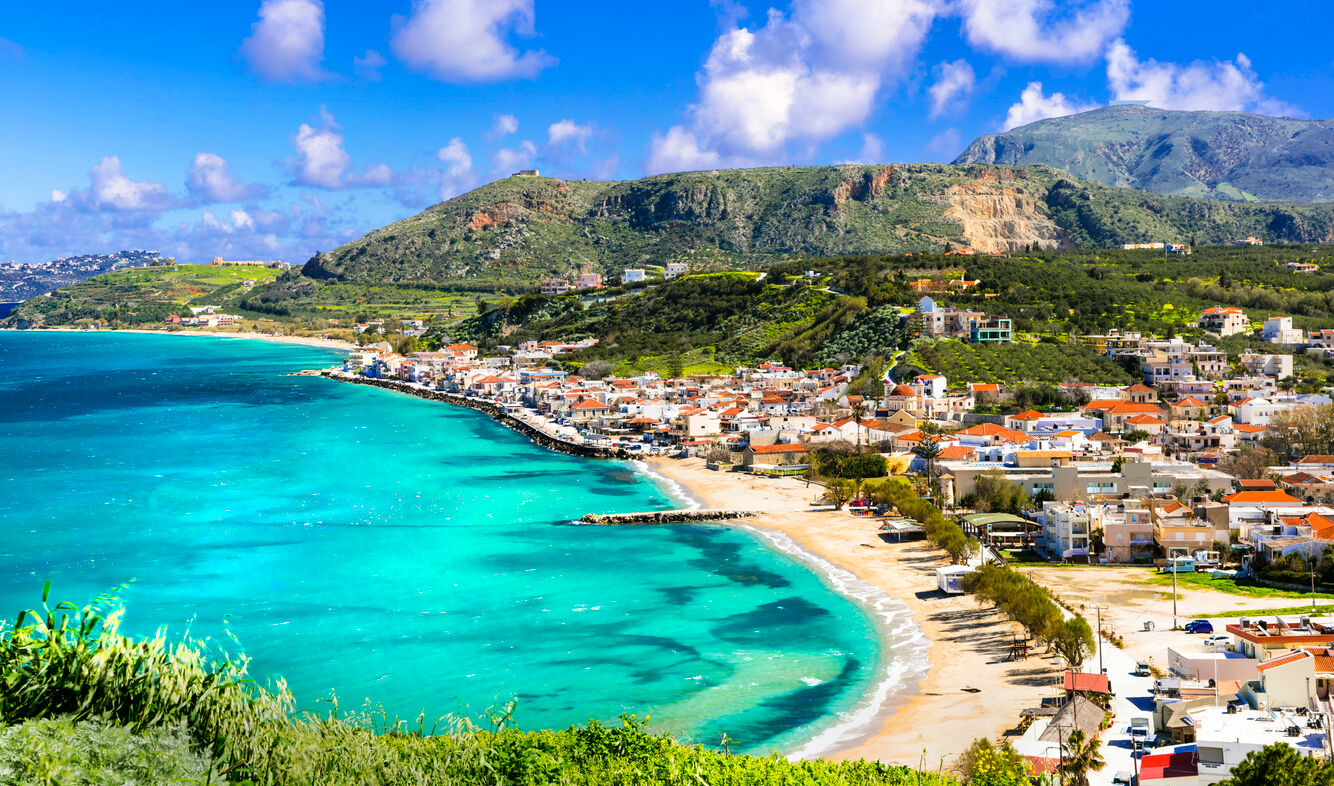
Explore Crete, Greece's largest island, a land of ancient myths, diverse landscapes from rugged mountains to stunning beaches like Elafonissi, Venetian harbours (Chania, Rethymno), and Minoan palaces.
Crete is the largest and most diverse of the Greek islands, offering Irish holidaymakers an extraordinary range of experiences within a single destination. The island's north coast is home to well-developed resort towns including Heraklion, Chania, Rethymno, Hersonissos and Malia, each with its own character — from the Venetian harbour charm of Chania to the lively beach scene of Malia. Crete's interior reveals a different world entirely, with dramatic gorges like the famous Samaria Gorge, snow-capped mountains, and traditional mountain villages where life has changed little in centuries. The island's Minoan heritage is remarkable — the palace of Knossos near Heraklion dates back over 4,000 years and is considered the cradle of European civilisation. Cretan cuisine is legendary, built on superb local olive oil, wild herbs, fresh seafood and the famous raki spirit offered at the end of every meal. Direct flights from Dublin reach Crete in around four hours, and the island's warm hospitality and excellent value make it a firm favourite with Irish families and couples seeking genuine Greek character alongside sun and beach.
Culture and Experiences
What's Nearby?
Santorini Day Trip
– Fast ferry from Heraklion to Santorini takes approximately 2 hours — a popular day trip.
Spinalonga Island
– Former Venetian fortress and leper colony off Elounda, reached by short boat trip. Atmospheric and moving.
Preveli Beach
– Palm-lined river meets the sea at this stunning south-coast beach, reached by a scenic drive through the mountains.
History
Minoan Civilisation
– Crete was the centre of Europe's first advanced civilisation from around 2700 BC.
Venetian Rule
– Venice controlled Crete for over 400 years (1204-1669).
Battle of Crete (1941)
– The fierce WWII airborne battle is commemorated in museums across the island.
Local Markets
Heraklion Central Market (1866 Street)
– Bustling covered market selling herbs, cheese, honey, olive oil and souvenirs.
Chania Agora (Covered Market)
– Cross-shaped market hall built in 1913 selling local produce and leather goods.
Events and Festivals
Carnival (February-March)
– Rethymno hosts Crete's biggest carnival with parades and street parties.
Wine Festival (July-August)
– Heraklion's wine festival with tastings, music and dancing.
Assumption of Mary (15 August)
– Major religious festival celebrated across Crete.
Local Etiquette
Hospitality
– Cretan hospitality is legendary. Accepting offered raki or food is polite.
Dress at Churches
– Cover shoulders and knees when visiting monasteries and churches.
Tipping
– Rounding up the bill or leaving 5-10% is customary.
Dining and Night Life
Local Cuisine
Dakos
– Crete's signature starter — barley rusks topped with chopped tomato, mizithra cheese, olive oil and oregano.
Lamb with Stamnagathi
– Slow-cooked lamb with wild Cretan greens, a mountain dish.
Cretan Olive Oil
– Crete produces some of the world's finest olive oil.
Raki (Tsikoudia)
– The local spirit, offered free at the end of meals in most traditional restaurants.
Night Life
Hersonissos & Malia
– The main party resorts on Crete's north coast.
Chania Harbour Bars
– Atmospheric cocktail bars lining the Venetian harbour.
Heraklion City
– University city with year-round nightlife along Korai Street.

Read Time: 5 mins
Chania is widely regarded as the most beautiful city on Crete and one of the most atmospheric in all of Greece. Its magnificent Venetian harbour, with its iconic lighthouse and pastel-coloured waterfront buildings, is one of the most photographed locations in the Mediterranean. Behind the harbour, the old town is a maze of narrow lanes, Ottoman mosques, Venetian mansions and hidden courtyards. Combined with some of the finest beaches in Europe nearby, Chania offers a holiday that satisfies both cultural curiosity and beach-loving relaxation.
Location and Getting There
Chania is on Crete's north-west coast. Chania International Airport (CHQ) is approximately fifteen minutes from the city centre. Alternatively, Heraklion Airport (HER) is around two and a half hours' drive to the east. The flight from Dublin takes approximately four hours. Chania's western location on Crete means it is the gateway to some of the island's most spectacular scenery, including the Samaria Gorge and the south-west coast beaches.
Beaches
The beaches near Chania are among the best in the Mediterranean. Elafonissi, on the south-west coast around ninety minutes' drive, is consistently ranked among Europe's finest beaches — its pink-tinged sand and shallow turquoise lagoon are genuinely breathtaking. Balos lagoon, accessible by boat from Kissamos or via a challenging dirt road, is equally spectacular. Closer to the city, Agia Marina, Platanias and Gerani offer sandy beaches with full resort facilities within twenty minutes' drive. The beach at Marathi on the Akrotiri peninsula is a sheltered gem.
Greek beaches are renowned worldwide for their water clarity, and the islands consistently rank among Europe's top beach destinations. The combination of the Mediterranean climate, clean seas and varied coastline — from wide sandy stretches to intimate pebble coves — means there is a beach for every preference. Many Greek beaches are backed by tavernas where you can enjoy fresh fish and a cold beer just metres from the water. Beach etiquette in Greece is relaxed, and public access to the shoreline is protected by law, though sunbed areas on popular beaches are typically managed by nearby businesses.
Things to Do
The old town is an attraction in itself — you could spend days exploring its Venetian and Ottoman architecture, artisan workshops, museums and hidden corners. The Maritime Museum in the Venetian dockyard tells the story of Crete's seafaring heritage. The Samaria Gorge, Europe's longest gorge at sixteen kilometres, is one of Crete's most popular excursions — the walk through the gorge from the White Mountains down to the Libyan Sea is unforgettable. Boat trips along the coast, visits to traditional mountain villages, and the Botanical Park of Crete are all excellent options.
Island-hopping is one of the great pleasures of a Greek holiday, and even if you are based on one island, day trips to nearby islands are often available by ferry or excursion boat. The Greek islands also offer a range of cultural experiences beyond the major archaeological sites — local festivals (panigiri), the evening volta (the traditional evening stroll), and the simple pleasure of sitting in a village square watching the world go by while sipping a cold frappe coffee. For active visitors, kayaking, hiking the coastal paths and cycling are increasingly popular ways to explore the island landscapes away from the beach.
Dining and Nightlife
Chania's dining scene is the best in western Crete and among the finest on the island. The harbour is lined with restaurants, though the quality varies — heading into the backstreets of the old town generally yields better food at lower prices. Cretan cuisine here is exceptional: lamb with stamnagathi (wild greens), boureki (courgette and cheese pie), fresh fish and locally produced olive oil feature prominently. The market hall (Agora) is worth a visit for cheese, honey, herbs and wine. Nightlife ranges from atmospheric cocktail bars in restored Venetian buildings to a club scene in the Splantzia quarter.
One of the great joys of eating in Greece is the emphasis on fresh, seasonal ingredients prepared simply. The taverna culture — where you might choose your fish from a display, point at dishes in the kitchen, or simply ask what is good today — creates a personal, unhurried dining experience that is central to Greek island life. Raki or tsipouro (the local grape spirits) are often offered free at the end of a meal as a gesture of hospitality. Greek wine has improved enormously in recent decades, and island wineries are producing labels that increasingly challenge the old assumption that Greek wine begins and ends with retsina. Vegetarian visitors will find Greece particularly accommodating — dishes like gigantes (giant beans), briam (roasted vegetables), spanakopita and the ubiquitous Greek salad with local feta make for excellent meat-free eating.
Best Time to Visit
May to October is the main season. June and September are optimal — warm without the extreme heat of July and August, and less crowded. The Samaria Gorge is open from May to October. Spring brings wildflowers; autumn brings warm seas and golden light.
Practical Information for Irish Visitors
Greece is in the EU. Euro, no visa. Two hours ahead of Ireland. English widely spoken. Hire car recommended for exploring the beaches and countryside.
Healthcare is available through the European Health Insurance Card (EHIC), but comprehensive travel insurance is strongly advised. Greek pharmacies are well equipped and pharmacists are knowledgeable — for minor ailments, a pharmacy visit is often sufficient. Tap water quality varies by island — on the larger islands it is generally safe, but bottled water is cheap and widely preferred. Greek time is two hours ahead of Ireland year-round, which is worth noting when calling home or planning flight connections. The pace of life in Greece is famously relaxed, with late dinners (often starting at nine or ten in the evening) and a general emphasis on enjoying the moment rather than rushing through the day.
Why Book with Sunholidays.ie
Sunholidays.ie is Irish-owned and IAA licensed (Licence No. T0601). Twenty euro per person deposit, monthly payments, price match guarantee. The team can help you find the right base for exploring Chania and western Crete.

Read Time: 5 mins
Rethymno sits midway along Crete's north coast, a university town that successfully blends a rich historical heritage with a youthful energy and one of the longest sandy beaches on the island. Its compact old town, dominated by the massive Venetian Fortezza fortress, is a fascinating tangle of narrow streets where Venetian elegance meets Ottoman minarets. For Irish visitors who want a beach holiday enriched by history, excellent dining and authentic Greek life, Rethymno strikes a perfect balance.
Location and Getting There
Rethymno is on Crete's north coast, approximately one hour's drive west of Heraklion Airport (HER) and one hour east of Chania Airport (CHQ). The flight from Dublin takes around four hours. The town's central position on the island makes it a good base for exploring both eastern and western Crete.
Beaches
Rethymno's main beach extends for twelve kilometres east of the old town — an enormous stretch of golden sand that begins right at the edge of the historic centre and continues along a developed resort strip. The beach has full facilities, including sunbeds, parasols, water sports and lifeguards. Its length means you can always find space, even in peak season. Preveli Beach, on the south coast about forty minutes' drive, is one of Crete's most dramatic — a palm-fringed river mouth opening onto a sandy beach backed by a gorge. Plakias, also on the south coast, offers a more laid-back beach experience.
Greek beaches are renowned worldwide for their water clarity, and the islands consistently rank among Europe's top beach destinations. The combination of the Mediterranean climate, clean seas and varied coastline — from wide sandy stretches to intimate pebble coves — means there is a beach for every preference. Many Greek beaches are backed by tavernas where you can enjoy fresh fish and a cold beer just metres from the water. Beach etiquette in Greece is relaxed, and public access to the shoreline is protected by law, though sunbed areas on popular beaches are typically managed by nearby businesses.
Things to Do
The Fortezza, a massive sixteenth-century Venetian fortress, crowns the headland above the old town and offers panoramic views and a venue for summer concerts. The old town below is a delight to explore — Venetian loggias, Ottoman fountains, the Neratzes Mosque (now a concert hall) and the Rimondi Fountain all tell the story of the town's layered history. The Historical and Folk Art Museum gives insight into traditional Cretan life. Day trips to the Arkadi Monastery (a symbol of Cretan resistance), the Amari Valley and the south coast beaches round out the excursion options. Rethymno's status as a university town gives it a lively, year-round cultural scene with galleries, bookshops and independent cafes.
Island-hopping is one of the great pleasures of a Greek holiday, and even if you are based on one island, day trips to nearby islands are often available by ferry or excursion boat. The Greek islands also offer a range of cultural experiences beyond the major archaeological sites — local festivals (panigiri), the evening volta (the traditional evening stroll), and the simple pleasure of sitting in a village square watching the world go by while sipping a cold frappe coffee. For active visitors, kayaking, hiking the coastal paths and cycling are increasingly popular ways to explore the island landscapes away from the beach.
Dining and Nightlife
The old town and Venetian harbour have an excellent concentration of restaurants and tavernas. Cretan cooking is the highlight — slow-cooked lamb, fresh fish, wild greens, local cheese and olive oil. The harbour is atmospheric but can be pricier; the backstreets offer better value. Rethymno's student population keeps the bar and nightlife scene vibrant, with a cluster of bars and clubs around the old town that come alive in summer. It is one of the liveliest nights out on Crete outside Heraklion.
One of the great joys of eating in Greece is the emphasis on fresh, seasonal ingredients prepared simply. The taverna culture — where you might choose your fish from a display, point at dishes in the kitchen, or simply ask what is good today — creates a personal, unhurried dining experience that is central to Greek island life. Raki or tsipouro (the local grape spirits) are often offered free at the end of a meal as a gesture of hospitality. Greek wine has improved enormously in recent decades, and island wineries are producing labels that increasingly challenge the old assumption that Greek wine begins and ends with retsina. Vegetarian visitors will find Greece particularly accommodating — dishes like gigantes (giant beans), briam (roasted vegetables), spanakopita and the ubiquitous Greek salad with local feta make for excellent meat-free eating.
Best Time to Visit
May to October is the main season. June and September offer the best balance of weather and crowds. The beach is enjoyable from late April through October. Summer evenings in the old town are magical.
Practical Information for Irish Visitors
Greece is in the EU. Euro, no visa. Two hours ahead of Ireland. English widely spoken. Tipping five to ten percent is appreciated.
Healthcare is available through the European Health Insurance Card (EHIC), but comprehensive travel insurance is strongly advised. Greek pharmacies are well equipped and pharmacists are knowledgeable — for minor ailments, a pharmacy visit is often sufficient. Tap water quality varies by island — on the larger islands it is generally safe, but bottled water is cheap and widely preferred. Greek time is two hours ahead of Ireland year-round, which is worth noting when calling home or planning flight connections. The pace of life in Greece is famously relaxed, with late dinners (often starting at nine or ten in the evening) and a general emphasis on enjoying the moment rather than rushing through the day.
Why Book with Sunholidays.ie
Sunholidays.ie is Irish-owned and IAA licensed (Licence No. T0601). Twenty euro per person deposit, monthly payments, price match guarantee. The team can recommend the right hotel — whether in the atmospheric old town or along the resort beach strip.

Read Time: 5 mins
Hersonissos is Crete's liveliest resort town, a purpose-built holiday strip on the north coast that caters to visitors who want beaches, entertainment and nightlife alongside their Greek island sunshine. Popular with younger travellers and families alike, Hersonissos offers a full resort experience with the cultural richness of Crete readily accessible for those who want to explore beyond the poolside. For Irish visitors seeking a lively base on Crete, Hersonissos delivers energy and convenience.
Location and Getting There
Hersonissos is on Crete's north coast, approximately twenty-five minutes east of Heraklion Airport (HER). The flight from Dublin takes around four hours. The short transfer is a significant advantage. The resort sits along the main coastal road, with hotels, shops and restaurants stretching for several kilometres.
Beaches
The resort has several small beaches, including Limanakia in the centre and Star Beach to the east. Star Beach is the most popular, a well-organised stretch of sand with water sports, a water park section and beach bars. The beaches are pleasant but not Crete's most spectacular — they are sandy, well-maintained and convenient for the resort. For more dramatic scenery, the beaches of the south coast and the palm beach of Vai in the east are within day-trip distance.
Greek beaches are renowned worldwide for their water clarity, and the islands consistently rank among Europe's top beach destinations. The combination of the Mediterranean climate, clean seas and varied coastline — from wide sandy stretches to intimate pebble coves — means there is a beach for every preference. Many Greek beaches are backed by tavernas where you can enjoy fresh fish and a cold beer just metres from the water. Beach etiquette in Greece is relaxed, and public access to the shoreline is protected by law, though sunbed areas on popular beaches are typically managed by nearby businesses.
Things to Do
Acqua Plus Water Park, a few kilometres inland, is a popular family attraction with slides, pools and a lazy river. Star Beach Water Park on the eastern end of the resort is another option. The Lychnostatis Open Air Museum provides an interesting look at traditional Cretan life. The Cretaquarium in nearby Gournes is one of the best aquariums in the eastern Mediterranean. For culture, the Palace of Knossos is a twenty-minute drive west, and the Heraklion Archaeological Museum is not much further. The Lassithi Plateau and the Dikteon Cave (mythical birthplace of Zeus) are accessible day trips.
Island-hopping is one of the great pleasures of a Greek holiday, and even if you are based on one island, day trips to nearby islands are often available by ferry or excursion boat. The Greek islands also offer a range of cultural experiences beyond the major archaeological sites — local festivals (panigiri), the evening volta (the traditional evening stroll), and the simple pleasure of sitting in a village square watching the world go by while sipping a cold frappe coffee. For active visitors, kayaking, hiking the coastal paths and cycling are increasingly popular ways to explore the island landscapes away from the beach.
Dining and Nightlife
Hersonissos has a vast range of restaurants along its main strip — Greek tavernas, seafood restaurants, Italian, Indian, Chinese and fast food are all well represented. Quality varies, but there are some good traditional tavernas in the old harbour area and the village on the hill above the resort. Nightlife is Hersonissos's calling card — the main strip has dozens of bars and clubs that keep going until the early hours. The scene is predominantly young and energetic, though there are quieter options for those who prefer a gentler evening.
One of the great joys of eating in Greece is the emphasis on fresh, seasonal ingredients prepared simply. The taverna culture — where you might choose your fish from a display, point at dishes in the kitchen, or simply ask what is good today — creates a personal, unhurried dining experience that is central to Greek island life. Raki or tsipouro (the local grape spirits) are often offered free at the end of a meal as a gesture of hospitality. Greek wine has improved enormously in recent decades, and island wineries are producing labels that increasingly challenge the old assumption that Greek wine begins and ends with retsina. Vegetarian visitors will find Greece particularly accommodating — dishes like gigantes (giant beans), briam (roasted vegetables), spanakopita and the ubiquitous Greek salad with local feta make for excellent meat-free eating.
Best Time to Visit
The season runs from April to October. July and August are the hottest and busiest months. June and September offer warm weather, warm sea and a slightly less frenetic atmosphere. The nightlife scene peaks in July and August.
Practical Information for Irish Visitors
Greece is in the EU. Euro, no visa. Two hours ahead of Ireland. English very widely spoken in Hersonissos.
Healthcare is available through the European Health Insurance Card (EHIC), but comprehensive travel insurance is strongly advised. Greek pharmacies are well equipped and pharmacists are knowledgeable — for minor ailments, a pharmacy visit is often sufficient. Tap water quality varies by island — on the larger islands it is generally safe, but bottled water is cheap and widely preferred. Greek time is two hours ahead of Ireland year-round, which is worth noting when calling home or planning flight connections. The pace of life in Greece is famously relaxed, with late dinners (often starting at nine or ten in the evening) and a general emphasis on enjoying the moment rather than rushing through the day.
Why Book with Sunholidays.ie
Sunholidays.ie is Irish-owned and IAA licensed (Licence No. T0601). Twenty euro per person deposit, monthly payments, price match guarantee. The team can place you in the right part of Hersonissos — beachside for families, main strip for nightlife seekers.

Read Time: 5 mins
Malia has a dual personality that makes it one of Crete's most interesting resorts. On one hand, it has a famous party strip that draws young holidaymakers from across Europe. On the other, it has a genuine Cretan old village, a long golden beach and the remains of a Minoan palace that rivals Knossos in archaeological importance. This combination of beach-holiday fun and real cultural substance gives Malia more depth than its party reputation might suggest. For younger Irish travellers and groups of friends, Malia offers a memorable holiday.
Location and Getting There
Malia is on Crete's north coast, approximately thirty-five minutes east of Heraklion Airport (HER). The flight from Dublin takes around four hours. The resort sits between Hersonissos to the west and Agios Nikolaos to the east.
Beaches
Malia Beach is one of the finest on Crete's north coast — a long, wide stretch of golden sand with gently shelving water and full facilities. The beach extends for several kilometres and has plenty of room even at the height of summer. Potamos Beach at the western end of the resort is quieter and more natural. Malia also has a number of smaller cove beaches accessible from the main beach strip. The sand quality and water clarity are genuinely good.
Greek beaches are renowned worldwide for their water clarity, and the islands consistently rank among Europe's top beach destinations. The combination of the Mediterranean climate, clean seas and varied coastline — from wide sandy stretches to intimate pebble coves — means there is a beach for every preference. Many Greek beaches are backed by tavernas where you can enjoy fresh fish and a cold beer just metres from the water. Beach etiquette in Greece is relaxed, and public access to the shoreline is protected by law, though sunbed areas on popular beaches are typically managed by nearby businesses.
Things to Do
The Malia Minoan Palace, located on the eastern edge of the resort, is one of the three great Minoan palatial centres of Crete. Less visited and less reconstructed than Knossos, it offers a more atmospheric archaeological experience. The old village of Malia, inland from the resort strip, is a genuine Cretan settlement with churches, tavernas and a traditional weekly market. Water sports are available on the beach. Day trips to Knossos, the Lassithi Plateau and the south coast are all feasible.
Island-hopping is one of the great pleasures of a Greek holiday, and even if you are based on one island, day trips to nearby islands are often available by ferry or excursion boat. The Greek islands also offer a range of cultural experiences beyond the major archaeological sites — local festivals (panigiri), the evening volta (the traditional evening stroll), and the simple pleasure of sitting in a village square watching the world go by while sipping a cold frappe coffee. For active visitors, kayaking, hiking the coastal paths and cycling are increasingly popular ways to explore the island landscapes away from the beach.
Dining and Nightlife
The resort strip has a wide selection of restaurants, bars and fast-food outlets. The old village offers better traditional Cretan dining in a more authentic setting. Nightlife is what Malia is best known for — the strip has a concentration of bars and clubs that create one of the liveliest party atmospheres in the Greek islands. The scene is predominantly young (eighteen to thirty) and centres on dance music, drinks promotions and themed nights. It is not for everyone, but for those who enjoy it, Malia delivers.
One of the great joys of eating in Greece is the emphasis on fresh, seasonal ingredients prepared simply. The taverna culture — where you might choose your fish from a display, point at dishes in the kitchen, or simply ask what is good today — creates a personal, unhurried dining experience that is central to Greek island life. Raki or tsipouro (the local grape spirits) are often offered free at the end of a meal as a gesture of hospitality. Greek wine has improved enormously in recent decades, and island wineries are producing labels that increasingly challenge the old assumption that Greek wine begins and ends with retsina. Vegetarian visitors will find Greece particularly accommodating — dishes like gigantes (giant beans), briam (roasted vegetables), spanakopita and the ubiquitous Greek salad with local feta make for excellent meat-free eating.
Best Time to Visit
The party season runs from June to September, peaking in July and August. For a quieter Malia experience with beach time and sightseeing, May and October are pleasant. The beach is enjoyable from May through October.
Practical Information for Irish Visitors
Greece is in the EU. Euro, no visa. Two hours ahead of Ireland. English very widely spoken in the resort.
Healthcare is available through the European Health Insurance Card (EHIC), but comprehensive travel insurance is strongly advised. Greek pharmacies are well equipped and pharmacists are knowledgeable — for minor ailments, a pharmacy visit is often sufficient. Tap water quality varies by island — on the larger islands it is generally safe, but bottled water is cheap and widely preferred. Greek time is two hours ahead of Ireland year-round, which is worth noting when calling home or planning flight connections. The pace of life in Greece is famously relaxed, with late dinners (often starting at nine or ten in the evening) and a general emphasis on enjoying the moment rather than rushing through the day.
Why Book with Sunholidays.ie
Sunholidays.ie is Irish-owned and IAA licensed (Licence No. T0601). Twenty euro per person deposit, monthly payments, price match guarantee. The team understands Malia's different zones and can place you in the right part of the resort for your group.

Read Time: 5 mins
Elounda is Crete's most prestigious resort, a small coastal settlement on the shores of Mirabello Bay that has become synonymous with luxury Mediterranean holidays. The bay's crystal-clear waters, the dramatic views across to the island fortress of Spinalonga, and a collection of world-class hotels have established Elounda as a destination for discerning travellers. For Irish visitors looking for a special occasion or a genuinely premium Crete experience, Elounda is the top choice on the island.
Location and Getting There
Elounda is on the north-east coast of Crete, overlooking the Gulf of Mirabello. Heraklion Airport (HER) is approximately one hour's drive to the west. The flight from Dublin takes around four hours. The road from the airport passes through Agios Nikolaos before climbing over a headland and descending to the stunning Elounda bay — the first view of the bay is genuinely memorable.
Beaches
Elounda's coastline is a mix of small sandy beaches and sheltered coves. The main village beach is pleasant and well-maintained. Many of the luxury hotels have their own private beaches and beach clubs, which is part of the appeal for guests. The causeway connecting to the Spinalonga peninsula (not to be confused with Spinalonga Island) has shallow, warm bathing areas on both sides. For a different beach experience, the small fishing village of Plaka, just north of Elounda, has a pebbly beach with extraordinary views of Spinalonga Island and excellent tavernas.
Greek beaches are renowned worldwide for their water clarity, and the islands consistently rank among Europe's top beach destinations. The combination of the Mediterranean climate, clean seas and varied coastline — from wide sandy stretches to intimate pebble coves — means there is a beach for every preference. Many Greek beaches are backed by tavernas where you can enjoy fresh fish and a cold beer just metres from the water. Beach etiquette in Greece is relaxed, and public access to the shoreline is protected by law, though sunbed areas on popular beaches are typically managed by nearby businesses.
Things to Do
The boat trip to Spinalonga Island is essential. This fortified islet, originally built by the Venetians and later used as a leper colony until 1957, is one of Crete's most visited historical sites and was the inspiration for Victoria Hislop's novel The Island. The island is remarkably well preserved and deeply moving. Within Elounda, the sunken ruins of the ancient city of Olous (visible in the shallow waters near the causeway) are intriguing. Boat trips around Mirabello Bay, diving in the clear waters, and visits to nearby Agios Nikolaos for shopping and dining round out the options.
Island-hopping is one of the great pleasures of a Greek holiday, and even if you are based on one island, day trips to nearby islands are often available by ferry or excursion boat. The Greek islands also offer a range of cultural experiences beyond the major archaeological sites — local festivals (panigiri), the evening volta (the traditional evening stroll), and the simple pleasure of sitting in a village square watching the world go by while sipping a cold frappe coffee. For active visitors, kayaking, hiking the coastal paths and cycling are increasingly popular ways to explore the island landscapes away from the beach.
Dining and Nightlife
Elounda's dining scene reflects its upmarket character. The village has several excellent tavernas and restaurants, many overlooking the bay and Spinalonga. Fresh fish, Cretan cuisine and Mediterranean fine dining are all represented. The luxury hotels have their own acclaimed restaurants, some with guest chefs. Plaka's waterfront tavernas offer a more informal, authentically Greek dining experience. Nightlife is refined — cocktail bars, hotel lounges and a quiet drink by the harbour. This is not a resort for clubbing.
One of the great joys of eating in Greece is the emphasis on fresh, seasonal ingredients prepared simply. The taverna culture — where you might choose your fish from a display, point at dishes in the kitchen, or simply ask what is good today — creates a personal, unhurried dining experience that is central to Greek island life. Raki or tsipouro (the local grape spirits) are often offered free at the end of a meal as a gesture of hospitality. Greek wine has improved enormously in recent decades, and island wineries are producing labels that increasingly challenge the old assumption that Greek wine begins and ends with retsina. Vegetarian visitors will find Greece particularly accommodating — dishes like gigantes (giant beans), briam (roasted vegetables), spanakopita and the ubiquitous Greek salad with local feta make for excellent meat-free eating.
Best Time to Visit
May to October, with June and September being particularly lovely. The bay is sheltered and calm, and the sea is warm from June through October. July and August are hot and busy. Spring brings wildflowers to the surrounding hills.
Practical Information for Irish Visitors
Greece is in the EU. Euro, no visa. Two hours ahead of Ireland. English widely spoken. A hire car is useful for exploring the region.
Healthcare is available through the European Health Insurance Card (EHIC), but comprehensive travel insurance is strongly advised. Greek pharmacies are well equipped and pharmacists are knowledgeable — for minor ailments, a pharmacy visit is often sufficient. Tap water quality varies by island — on the larger islands it is generally safe, but bottled water is cheap and widely preferred. Greek time is two hours ahead of Ireland year-round, which is worth noting when calling home or planning flight connections. The pace of life in Greece is famously relaxed, with late dinners (often starting at nine or ten in the evening) and a general emphasis on enjoying the moment rather than rushing through the day.
Why Book with Sunholidays.ie
Sunholidays.ie is Irish-owned and IAA licensed (Licence No. T0601). Twenty euro per person deposit, monthly payments, price match guarantee. The team can access deals at Elounda's premium properties that may not be available elsewhere.