
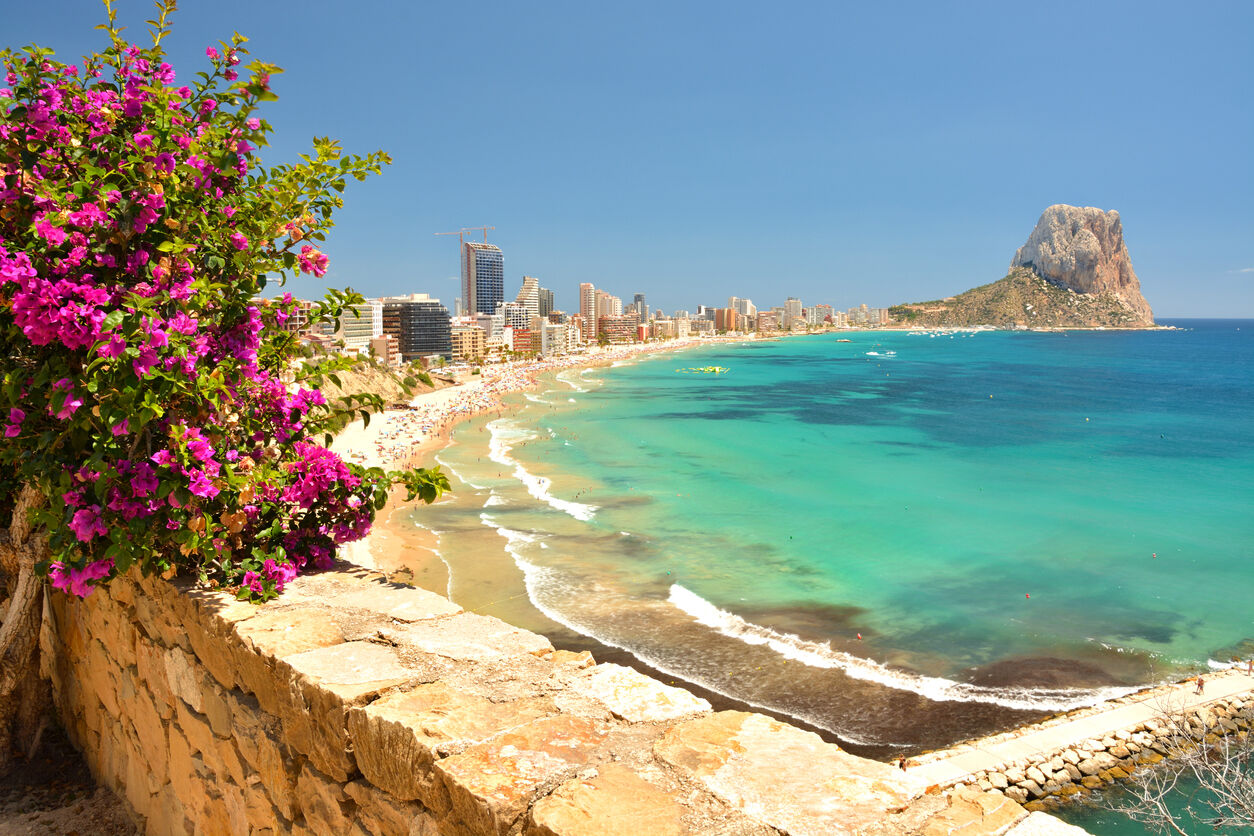
Costa Blanca
Weather
Local Information
Plug Socket Type
Type C/F (European two-pin). Irish visitors need a travel adapter.
Currency
Euro
Time Zones
GMT+1 (1 hour ahead of Ireland in winter, same in summer).
Local Emergency Contact
112 (general emergency). Irish Embassy Madrid: +34 914 364 093.
Travel Information
Flight Time
Approximately 2.5 hours from Dublin to Alicante (ALC). Year-round flights from Dublin, Cork and Shannon.
Distance from Beach
All Costa Blanca resorts are beachfront or within short walking distance.
Do I need a Visa?
No. Spain is an EU member state. Irish citizens need only a valid passport or identity card.
3 Things to do in Costa Blanca
Terra Mitica Theme Park
–Major theme park near Benidorm with zones based on ancient civilisations.
Guadalest Castle
–Dramatic hilltop castle and village in the mountains behind Benidorm.
Tabarca Island
–Boat trip from Alicante to Spain's smallest inhabited island — crystal water and excellent seafood.
Description
Explore the Costa Blanca, Spain's 'White Coast,' renowned for its vibrant resorts like Benidorm, beautiful sandy beaches, charming towns, and a sunny Mediterranean climate perfect for Irish holidaymakers.
The Costa Blanca, or "White Coast", runs along Spain's southeastern Mediterranean shoreline and is one of the most popular holiday destinations for Irish travellers seeking reliable sunshine and excellent value. The region's main resort, Benidorm, is famous for its dramatic skyline of high-rise hotels flanked by two magnificent sweeping beaches — Levante and Poniente — and offers an extraordinary concentration of entertainment, restaurants and nightlife. Beyond Benidorm, the Costa Blanca reveals a more varied character: the charming old town of Altea with its blue-domed church and artist community, the bustling market town of Calpe overshadowed by the dramatic Peñón de Ifach rock, and the quieter family resorts of Torrevieja and Guardamar del Segura further south. The regional capital Alicante is a lively port city with a hilltop castle, palm-lined promenade and excellent tapas bars. The Costa Blanca enjoys one of the healthiest climates in Europe according to the World Health Organisation, with warm, dry summers and mild winters. Direct flights from Dublin and Cork reach Alicante in around two and a half hours, making it one of the most accessible sun destinations for Irish holidaymakers.
Culture and Experiences
What's Nearby?
Alicante City
– Castle of Santa Barbara, Explanada promenade, old town tapas bars and the excellent MARQ archaeology museum.
Elche
– UNESCO-listed palm grove — the largest in Europe — and the famous Mystery Play of Elche (August).
Calpe
– Famous for the Penon de Ifach rock and excellent fish restaurants along the harbour.
History
Moorish Heritage
– The castle of Santa Barbara in Alicante and Guadalest in the mountains date from Moorish rule.
Roman Lucentum
– Alicante was founded as a Roman settlement. Archaeological remains at Tossal de Manises are open to visit.
Benidorm's Rise
– Benidorm was a small fishing village until the 1960s tourism boom transformed it into Spain's most famous high-rise resort.
Local Markets
Benidorm Market (Wednesday)
– Large outdoor market near the old town with clothing, leather goods, ceramics and local produce.
Alicante Central Market
– Modernist market building in the city centre with fresh produce, fish, meat and delicatessen items.
Events and Festivals
Hogueras de San Juan (June)
– Alicante's biggest festival — massive bonfires, fireworks and street parties around the summer solstice.
Moros y Cristianos
– Elaborate Moors and Christians festivals across the region, with parades and re-enactments. Alcoy's (April) is the most famous.
Benidorm Fiestas (November)
– Patron saint celebrations with fireworks, bull-running, parades and street entertainment.
Local Etiquette
Meal Times
– Lunch from 2pm, dinner from 9pm. Restaurants may not be open between 4-8pm.
Tipping
– Small change or 5-10% for good service. Not obligatory.
Beach Rules
– Spanish beaches generally have strict rules — check local signage regarding inflatables, dogs and ball games.
Dining and Night Life
Local Cuisine
Paella
– The Valencia region (which includes Costa Blanca) is the home of paella. Authentic versions use rice, rabbit, chicken and local beans — seafood paella is a coastal adaptation.
Arroz a Banda
– Rice cooked in rich fish stock, served separately from the fish. A Costa Blanca coastal speciality.
Turron
– Alicante and Jijona are the centres of Spain's turron (nougat) industry — almond-based confections available year-round.
Horchata
– Sweet tiger nut milk, best from Valencia. Refreshing cold drink on hot days.
Night Life
Benidorm
– Spain's entertainment capital with hundreds of bars, cabarets, live shows and late-night clubs across multiple zones.
Alicante Barrio
– The old town (El Barrio) in Alicante has a lively bar scene with tapas bars and music venues.
Torrevieja
– More relaxed evening atmosphere with waterfront bars and live entertainment.

Read Time: 4 mins
Benidorm is Spain's most famous resort and one of the most recognisable holiday destinations in the world. Its dramatic skyline of high-rise hotels and apartment blocks flanking two magnificent sandy beaches has been drawing Irish and British holidaymakers for over fifty years. Love it or roll your eyes, Benidorm delivers on its promise: reliable sunshine, excellent beaches, endless entertainment, and a holiday infrastructure so well-developed that virtually every need is catered for. For Irish visitors who want a guaranteed good time with maximum convenience, Benidorm remains the king of the package holiday.
Location and Getting There
Benidorm is on Spain's Costa Blanca, approximately forty minutes from Alicante Airport (ALC). The flight from Dublin takes around two and a half hours — one of the shortest sun holiday transfers from Ireland. The resort sits on a headland between two sweeping bays, with the old town perched on the rocky promontory between them.
Beaches
Benidorm has two outstanding beaches. Playa de Levante, on the eastern side, is the more famous — a wide, gently curving crescent of fine golden sand backed by the resort's main hotel and entertainment strip. It is one of the most well-maintained beaches in Spain, with sunbeds, parasols, showers and lifeguards. Playa de Poniente, on the western side, is equally long and wide but has a slightly more relaxed atmosphere. Both beaches hold Blue Flag status. Cala de Finestrat, just west of Poniente, is a smaller, more sheltered cove popular with families. The water at all beaches is clean, warm from June to October, and safe for swimming.
Spanish beaches are generally well maintained and regulated, with Blue Flag status widely held across the major resort areas. Most resort beaches have sunbed and parasol hire, lifeguard stations, shower facilities and nearby chiringuitos (beach bars) serving cold drinks and snacks. The Mediterranean sea is calm and warm from June through October, with water temperatures peaking around twenty-five degrees in August. The concept of the chiringuito — a simple beachside restaurant serving fresh fish, paella and cold beer — is central to the Spanish beach experience and represents some of the best-value eating on the coast.
Things to Do
Terra Mitica theme park, set in the hills above Benidorm, offers rides and entertainment based on ancient Mediterranean civilisations. Aqualandia water park is one of the largest in Europe. Mundomar marine park has dolphins, sea lions and exotic birds. Terra Natura is a zoo and aquarium complex. For a change of pace, the old town (Casco Antiguo) is a charming hilltop area of white houses, tapas bars and a famous viewpoint (Balcon del Mediterraneo) with views along both beaches. Guadalest, a spectacular cliff-top castle village in the mountains, is a popular day trip. The island of Benidorm (Illa de Benidorm) is visible offshore and can be visited by boat.
Dining and Nightlife
Benidorm has hundreds of restaurants covering every cuisine and budget. The Levante strip has the highest concentration, while the old town offers more authentic Spanish dining — tapas bars where you can eat excellent food at very reasonable prices. The Rincon de Loix area has a mix of international and Spanish restaurants. Nightlife is legendary — Benidorm has everything from Irish pubs and karaoke bars to cabaret shows, tribute acts, gay-friendly venues and late-night clubs. The entertainment scene caters to all ages, from family-friendly shows to the famous Benidorm Palace cabaret. The Calle Gerona strip is the main nightlife concentration.
Best Time to Visit
Benidorm has over three hundred days of sunshine per year. Summer temperatures range from twenty-eight to thirty-four degrees. Winter is mild (fifteen to twenty degrees), making Benidorm a popular winter sun destination for retirees. The peak summer months of July and August are the busiest and hottest. May, June, September and October offer excellent weather with fewer crowds.
Practical Information for Irish Visitors
Spain is in the EU. Euro, no visa. One hour ahead of Ireland. English is exceptionally widely spoken in Benidorm.
Spain's excellent healthcare system is accessible to Irish visitors through the European Health Insurance Card (EHIC), though travel insurance is always recommended. Pharmacies are identified by a green cross and are well stocked — pharmacists can advise on and dispense remedies for common complaints. Spain operates on a later daily schedule than Ireland — lunch is typically from two to four in the afternoon, and dinner rarely starts before nine. Adapting to this rhythm is part of the pleasure of a Spanish holiday. Supermarkets in resort areas stock familiar brands alongside excellent-value local wines, olive oil, cheese and cured meats. Mobile phone roaming within the EU means your Irish plan works in Spain at no extra cost.
Why Book with Sunholidays.ie
Sunholidays.ie is Irish-owned and IAA licensed (Licence No. T0601). Twenty euro per person deposit, monthly payments, price match guarantee. The team's extensive experience with Benidorm means they can navigate the huge range of hotels to find the right one for your budget and preferences.

Read Time: 5 mins
Torrevieja is a thriving Spanish coastal city on the southern Costa Blanca that offers a more authentic, less touristy experience than the big-name resorts further north. Famous for its remarkable pink salt lakes — a natural phenomenon caused by the high concentration of salt and microorganisms — Torrevieja has a genuine year-round community with an excellent market, good beaches and a multicultural atmosphere shaped by its large resident population of international expats. For Irish visitors who prefer a real Spanish town to a purpose-built resort, Torrevieja is a rewarding discovery.
Location and Getting There
Torrevieja is on the southern Costa Blanca, approximately forty-five minutes from Alicante Airport (ALC). The flight from Dublin takes around two and a half hours. The smaller Murcia Airport is also around forty-five minutes away. The town sits between the sea and its famous salt lagoons.
Beaches
Playa del Cura is the main central beach — a compact golden sand beach with full facilities right in the town centre. Playa de los Locos, to the south, is longer and very popular. Playa de la Mata to the north is a longer natural beach backed by dunes and a nature reserve — it is one of the finest beaches on the southern Costa Blanca. The coastline around Torrevieja also has rocky coves and small calas that are excellent for snorkelling and quieter sunbathing.
Spanish beaches are generally well maintained and regulated, with Blue Flag status widely held across the major resort areas. Most resort beaches have sunbed and parasol hire, lifeguard stations, shower facilities and nearby chiringuitos (beach bars) serving cold drinks and snacks. The Mediterranean sea is calm and warm from June through October, with water temperatures peaking around twenty-five degrees in August. The concept of the chiringuito — a simple beachside restaurant serving fresh fish, paella and cold beer — is central to the Spanish beach experience and represents some of the best-value eating on the coast.
Things to Do
The salt lakes (Lagunas de Torrevieja and La Mata) are a unique natural attraction and a Natural Park. The pink lagoon, coloured by Dunaliella salina algae, is extraordinarily photogenic. Birdwatching around the lagoons is excellent, with flamingos among the species present. The Floating Museum Submarine Delfin S-61, a decommissioned Spanish navy submarine in the harbour, is an unusual attraction. Torrevieja's Friday market is one of the biggest on the Costa Blanca. The aqua park and go-karting provide family entertainment. The historic centre has a pleasant paseo, churches and a cultural centre.
One of the great advantages of a Spanish holiday is the depth of cultural experiences available within easy reach of the beach resorts. Nearly every resort has a traditional old town or nearby village where you can experience authentic Spanish life — weekly markets selling local produce, parish churches with ornate interiors, and family-run restaurants serving dishes made from recipes handed down through generations. Spain also has an excellent network of public transport, making day trips to major cities and cultural sites straightforward. Museum cards and tourist passes often offer excellent value for families planning multiple visits to attractions.
Dining and Nightlife
Torrevieja has a genuine Spanish dining scene. The harbour area has excellent fish restaurants, and the town centre's tapas bars serve the kind of food that locals eat — fresh, flavourful and good value. The Friday market area has bars and cafes popular with the international community. Nightlife is moderate — there are bars, pubs and a few late-night venues, but Torrevieja is not a clubbing destination. The paseo maritimo is pleasant for evening walks.
The Spanish approach to eating is one of the great pleasures of a holiday. The tapas tradition encourages grazing, sharing and trying multiple small dishes — it is a social, convivial way to eat that suits groups, couples and families equally well. Each region of Spain has its own food identity and speciality dishes, so eating your way along the coast is a journey in itself. Spanish wine is extraordinary value — excellent Rioja, Ribera del Duero, Rueda and Cava can be enjoyed in restaurants at prices that would be unthinkable in Ireland. For self-caterers, Spanish supermarkets offer exceptional quality and value on local wines, olive oil, cheese and cured meats.
Best Time to Visit
Torrevieja has one of the best climates in Europe, officially recognised by the World Health Organisation. Year-round sunshine, mild winters and warm summers make it suitable in any month. The beaches are best from May to October. Spring and autumn are ideal for walking and sightseeing.
Practical Information for Irish Visitors
Spain is in the EU. Euro, no visa. One hour ahead of Ireland. English is widely spoken due to the large international community.
Spain's excellent healthcare system is accessible to Irish visitors through the European Health Insurance Card (EHIC), though travel insurance is always recommended. Pharmacies are identified by a green cross and are well stocked — pharmacists can advise on and dispense remedies for common complaints. Spain operates on a later daily schedule than Ireland — lunch is typically from two to four in the afternoon, and dinner rarely starts before nine. Adapting to this rhythm is part of the pleasure of a Spanish holiday. Supermarkets in resort areas stock familiar brands alongside excellent-value local wines, olive oil, cheese and cured meats. Mobile phone roaming within the EU means your Irish plan works in Spain at no extra cost.
Why Book with Sunholidays.ie
Sunholidays.ie is Irish-owned and IAA licensed (Licence No. T0601). Twenty euro per person deposit, monthly payments, price match guarantee. The team can help you find accommodation in this authentic Spanish destination.

Read Time: 0 min
Discover Alicante, a vibrant port city on the Costa Blanca, offering a beautiful palm-lined promenade, a historic castle (Santa Bárbara), lovely beaches, and a lively Spanish atmosphere for Irish visitors.