
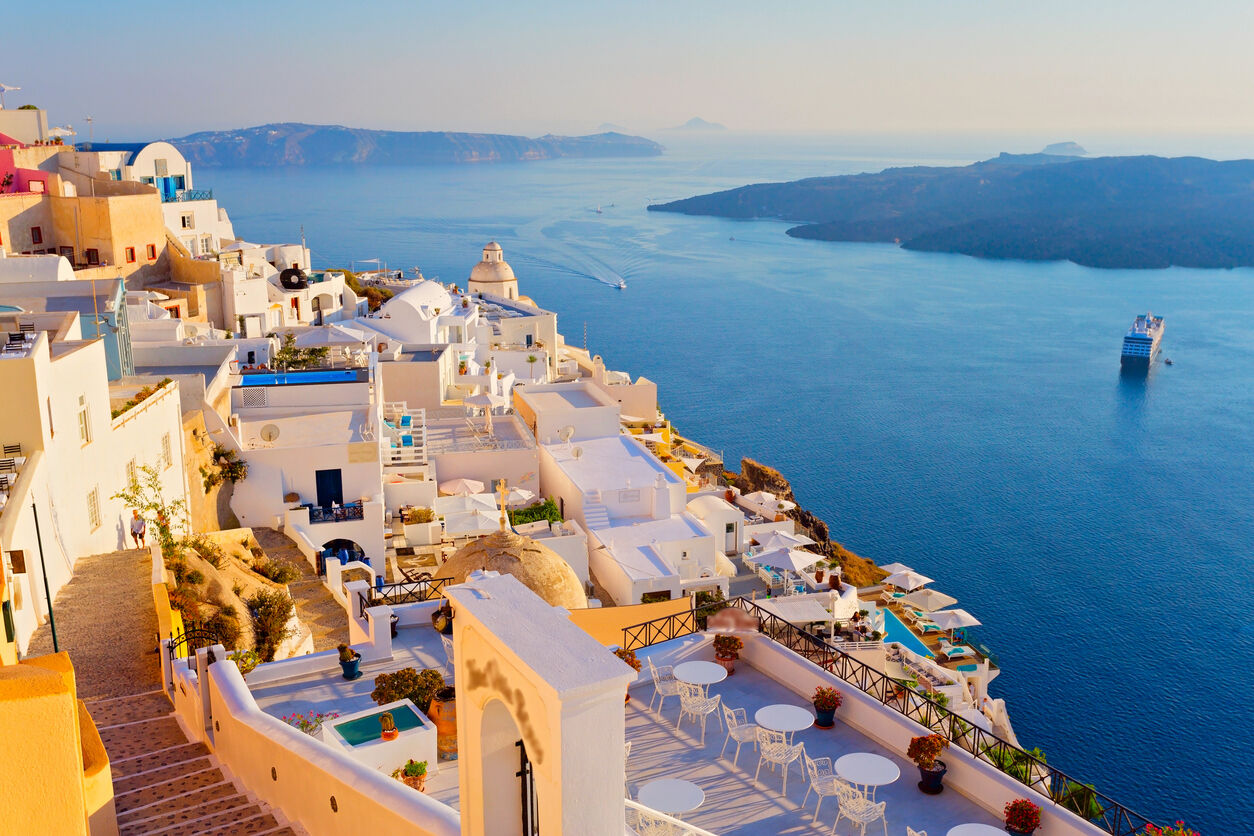
Santorini
Weather
Local Information
Plug Socket Type
Type C/F (European two-pin). Irish visitors need a travel adapter.
Currency
Euro
Time Zones
GMT+2 (2 hours ahead of Ireland year-round).
Local Emergency Contact
112 (general emergency). 166 (tourist police). Irish Embassy Athens: +30 210 723 2771.
Travel Information
Flight Time
Approximately 4 hours from Dublin. Seasonal flights May-October (often via Athens).
Distance from Beach
Depends on resort. Caldera villages (Fira, Oia) are cliff-top — beaches require bus or taxi. Perissa and Kamari are beachfront.
Do I need a Visa?
No. Greece is an EU member state. Irish citizens need only a valid passport or identity card.
3 Things to do in Santorini
Oia Sunset
–The world's most famous sunset spot — blue-domed churches against a fiery sky over the caldera.
Caldera Boat Trip
–Sail the volcanic caldera, swim in hot springs and visit the active volcanic island of Nea Kameni.
Red Beach (Kokkini)
–Dramatic red volcanic cliff beach near Akrotiri — one of the most photographed beaches in Greece.
Description
Experience Santorini, the iconic Greek Island famed for its breathtaking caldera sunsets, whitewashed villages clinging to cliffs (Oia, Fira), unique volcanic beaches, and romantic atmosphere, a dream for Irish visitors.
Santorini is one of the most iconic destinations in the world, and for good reason. This crescent-shaped volcanic island in the Cyclades captivates visitors with its dramatic caldera views, whitewashed villages perched on cliff edges, and sunsets that have become the stuff of legend. The main towns of Fira and Oia offer a magical blend of boutique hotels, excellent restaurants, wine bars and endless photo opportunities along winding cobblestone paths. Beyond the famous postcard views, Santorini offers unique volcanic beaches — the black sand of Perissa and Perivolos, and the striking red beach near Akrotiri — as well as world-class wineries producing the crisp, mineral Assyrtiko white wine from ancient volcanic vineyards. The archaeological site at Akrotiri, a Minoan city preserved by volcanic ash, rivals Pompeii in significance. For Irish visitors, Santorini is accessible via direct seasonal flights taking around four hours, and while it sits at the premium end of Greek island holidays, the experience of watching the sun set over the caldera from a clifftop restaurant is genuinely unforgettable.
Culture and Experiences
What's Nearby?
Akrotiri Archaeological Site
– A Minoan city preserved under volcanic ash — often called the 'Pompeii of the Aegean'.
Thirassia Island
– Small, quiet island across the caldera from Santorini, reached by boat. Traditional village life and excellent tavernas.
Ios & Mykonos
– Neighbouring Cycladic islands reachable by fast ferry for day trips or island-hopping.
History
Minoan Eruption (~1600 BC)
– One of the largest volcanic eruptions in recorded history.
Atlantis Connection
– Many scholars believe Santorini inspired Plato's legend of Atlantis.
Wine Heritage
– Santorini has produced wine for over 3,500 years.
Local Markets
Fira Central Square
– Small market area with local produce and volcanic-themed crafts.
Santo Wines Winery
– Wine tasting with caldera views at this cooperative winery.
Events and Festivals
Ifestia Festival (August)
– Volcanic eruption re-enactment with fireworks over the caldera.
Jazz Festival (July)
– International jazz performances in atmospheric venues.
Santorini Arts Factory (Summer)
– Exhibitions and concerts in a converted tomato factory.
Local Etiquette
Photography
– Ask before photographing locals. Many blue-domed churches are private.
Dress Code
– Santorini is more dressed up than other islands.
Tipping
– 5-10% is customary for good service.
Dining and Night Life
Local Cuisine
Fava
– Santorini's signature dish — creamy yellow split pea puree.
Cherry Tomatoes
– Santorini's tiny, intensely sweet cherry tomatoes grow in volcanic soil.
Assyrtiko Wine
– World-class white wine from ancient volcanic vineyards.
White Aubergine
– A local variety unique to Santorini — sweeter and less bitter.
Night Life
Fira Bars
– Cliff-side cocktail bars and caldera-view terraces.
Oia Sunset Bars
– Elegant cocktail bars perfect for sunset.
Perissa Beach Bars
– Relaxed beach bars along the black sand beach.

Read Time: 4 mins
Oia is the village that made Santorini famous. Perched on the northern tip of the island's volcanic caldera, its whitewashed buildings, blue-domed churches and legendary sunsets have become one of the most recognised images in world travel. Every evening, crowds gather at the castle ruins to watch the sun sink into the Aegean in a blaze of colour. But Oia is more than a sunset — it is a village of genuine beauty, with art galleries, boutique shops, excellent restaurants and a quieter, more refined atmosphere than the island capital Fira.
Location and Getting There
Oia occupies the northern tip of Santorini's caldera rim, approximately twenty-five minutes' drive from Thira Airport (JTR). The flight from Dublin takes around four hours. The village is connected to Fira and the rest of the island by a good road, and local buses run regularly. The approach to Oia, with the village spilling down the cliff face and the caldera stretching below, is one of the most dramatic arrivals in the Greek islands.
Beaches
Oia is not a beach destination in the conventional sense — it sits atop high cliffs. However, Amoudi Bay is accessible via a steep staircase of around three hundred steps from the village, and it is one of Santorini's most atmospheric spots — a tiny harbour with red volcanic cliffs, clear water for swimming and a couple of excellent fish tavernas. Baxedes Beach, below the village to the north, is a quiet volcanic beach. For dedicated beach days, the black sand beaches of Kamari and Perissa on the east coast are thirty to forty minutes' drive.
Greek beaches are renowned worldwide for their water clarity, and the islands consistently rank among Europe's top beach destinations. The combination of the Mediterranean climate, clean seas and varied coastline — from wide sandy stretches to intimate pebble coves — means there is a beach for every preference. Many Greek beaches are backed by tavernas where you can enjoy fresh fish and a cold beer just metres from the water. Beach etiquette in Greece is relaxed, and public access to the shoreline is protected by law, though sunbed areas on popular beaches are typically managed by nearby businesses.
Things to Do
Walking the caldera path from Oia to Fira is one of the finest walks in the Greek islands — approximately ten kilometres along the cliff edge with spectacular views of the volcanic caldera, the sea and the neighbouring islands. Within Oia, the castle ruins (the sunset-watching point), the Naval Maritime Museum, and the numerous art galleries and workshops are all worth exploring. Boat trips to the volcanic islands of Nea Kameni (where you can walk to the crater) and the hot springs of Palea Kameni are popular excursions. Wine tasting at Santorini's volcanic vineyards, where the grapes are grown in basket shapes close to the ground, is a unique experience.
Dining and Nightlife
Oia has some of Santorini's finest restaurants, many offering caldera views that would justify the visit alone. Fresh fish at Amoudi Bay is an essential experience. In the village itself, you will find refined Greek cuisine, creative Mediterranean cooking and excellent wine lists featuring the island's distinctive Assyrtiko grape. Dining in Oia is a special occasion by nature. Nightlife is sophisticated and subdued — cocktail bars with views, wine bars and the kind of evenings where conversation takes priority over volume.
Best Time to Visit
Santorini's season runs from April to October. Oia is at its most atmospheric in the shoulder months — May, early June, September and October — when the light is golden, the crowds are manageable and the sunsets are no less spectacular. July and August are very busy and very hot. The sunset experience is best enjoyed before or after the peak summer rush.
Practical Information for Irish Visitors
Greece is in the EU. Euro, no visa. Two hours ahead of Ireland. English widely spoken. Oia is one of the more expensive destinations in Greece — budget accordingly, particularly for dining and accommodation.
Healthcare is available through the European Health Insurance Card (EHIC), but comprehensive travel insurance is strongly advised. Greek pharmacies are well equipped and pharmacists are knowledgeable — for minor ailments, a pharmacy visit is often sufficient. Tap water quality varies by island — on the larger islands it is generally safe, but bottled water is cheap and widely preferred. Greek time is two hours ahead of Ireland year-round, which is worth noting when calling home or planning flight connections. The pace of life in Greece is famously relaxed, with late dinners (often starting at nine or ten in the evening) and a general emphasis on enjoying the moment rather than rushing through the day.
Why Book with Sunholidays.ie
Sunholidays.ie is Irish-owned and IAA licensed (Licence No. T0601). Twenty euro per person deposit, monthly payments, price match guarantee. Santorini accommodation books up quickly, so early booking through Sunholidays.ie is recommended to secure the best options.

Read Time: 5 mins
Fira is the bustling capital of Santorini, a town that cascades down the inner wall of the volcanic caldera in a cascade of white buildings, blue accents and terrace restaurants with views that stop you in your tracks. It is the commercial and social hub of the island, with the widest choice of shops, restaurants, bars and nightlife, as well as the cable car that connects the clifftop town to the old port below. For Irish visitors who want to be at the centre of the action on Santorini, Fira is the obvious base.
Location and Getting There
Fira sits roughly in the centre of Santorini's western coast, on the caldera rim. Thira Airport (JTR) is approximately fifteen minutes' drive to the south-east. The flight from Dublin takes around four hours. Fira is the island's transport hub, with bus services connecting to all major villages and beaches.
Beaches
Like Oia, Fira is a clifftop town without direct beach access. However, the island's beaches are easily reached from here. Kamari beach (black volcanic sand, well-organised with sunbeds and tavernas) and Perissa beach (also black sand, with a younger, more relaxed vibe) are both around fifteen minutes by bus or car on the east coast. Red Beach near Akrotiri is dramatic and unique, with red volcanic cliffs and dark sand. The cable car from Fira descends to the old port, where you can swim off the rocks or catch boats to the volcano.
Greek beaches are renowned worldwide for their water clarity, and the islands consistently rank among Europe's top beach destinations. The combination of the Mediterranean climate, clean seas and varied coastline — from wide sandy stretches to intimate pebble coves — means there is a beach for every preference. Many Greek beaches are backed by tavernas where you can enjoy fresh fish and a cold beer just metres from the water. Beach etiquette in Greece is relaxed, and public access to the shoreline is protected by law, though sunbed areas on popular beaches are typically managed by nearby businesses.
Things to Do
The Museum of Prehistoric Thera and the Archaeological Museum are both in Fira and house remarkable finds from the Akrotiri excavations — a Minoan settlement buried by the volcanic eruption around 1600 BC, often compared to Pompeii. Akrotiri itself is one of the most significant archaeological sites in the Aegean and is well worth a half-day visit. The cable car ride between Fira and the old port is a Santorini experience in itself, offering sweeping caldera views. The caldera walk to Imerovigli and onwards to Oia is a highlight. Boat trips to the volcano and hot springs depart from the old port.
Island-hopping is one of the great pleasures of a Greek holiday, and even if you are based on one island, day trips to nearby islands are often available by ferry or excursion boat. The Greek islands also offer a range of cultural experiences beyond the major archaeological sites — local festivals (panigiri), the evening volta (the traditional evening stroll), and the simple pleasure of sitting in a village square watching the world go by while sipping a cold frappe coffee. For active visitors, kayaking, hiking the coastal paths and cycling are increasingly popular ways to explore the island landscapes away from the beach.
Dining and Nightlife
Fira has Santorini's widest dining selection, from simple gyros shops to caldera-view restaurants with creative Greek cuisine. The caldera-edge restaurants come at a premium, but the views justify it for a special evening. For better value, the backstreets have excellent tavernas serving traditional Greek food. Nightlife in Fira is the liveliest on the island — there are cocktail bars with caldera views, music bars, clubs and a buzzing atmosphere that extends into the small hours during summer. The nightlife strip along the caldera edge is particularly atmospheric.
One of the great joys of eating in Greece is the emphasis on fresh, seasonal ingredients prepared simply. The taverna culture — where you might choose your fish from a display, point at dishes in the kitchen, or simply ask what is good today — creates a personal, unhurried dining experience that is central to Greek island life. Raki or tsipouro (the local grape spirits) are often offered free at the end of a meal as a gesture of hospitality. Greek wine has improved enormously in recent decades, and island wineries are producing labels that increasingly challenge the old assumption that Greek wine begins and ends with retsina. Vegetarian visitors will find Greece particularly accommodating — dishes like gigantes (giant beans), briam (roasted vegetables), spanakopita and the ubiquitous Greek salad with local feta make for excellent meat-free eating.
Best Time to Visit
April to October, with May, June and September being optimal. July and August are very hot and very crowded — Fira in particular can feel overwhelmed by cruise-ship day visitors during peak hours. Visiting in shoulder season gives you a much more enjoyable experience of this beautiful town.
Practical Information for Irish Visitors
Greece is in the EU. Euro, no visa. Two hours ahead of Ireland. English very widely spoken. Santorini is one of Greece's more expensive islands.
Healthcare is available through the European Health Insurance Card (EHIC), but comprehensive travel insurance is strongly advised. Greek pharmacies are well equipped and pharmacists are knowledgeable — for minor ailments, a pharmacy visit is often sufficient. Tap water quality varies by island — on the larger islands it is generally safe, but bottled water is cheap and widely preferred. Greek time is two hours ahead of Ireland year-round, which is worth noting when calling home or planning flight connections. The pace of life in Greece is famously relaxed, with late dinners (often starting at nine or ten in the evening) and a general emphasis on enjoying the moment rather than rushing through the day.
Why Book with Sunholidays.ie
Sunholidays.ie is Irish-owned and IAA licensed (Licence No. T0601). Twenty euro per person deposit, monthly payments, price match guarantee. Book early for the best Santorini options.

Read Time: 5 mins
Imerovigli is the highest village on Santorini's caldera rim, earning it the nickname the balcony to the Aegean. This small, peaceful settlement sits between Fira and Oia, offering arguably the most spectacular views on an island famous for spectacular views. It is quieter and more intimate than both its neighbours, making it the choice for couples seeking romance and travellers who want to experience Santorini's beauty without the crowds. The dramatic Skaros Rock, a Venetian castle ruin jutting out into the caldera, adds a touch of adventure to the serenity.
Location and Getting There
Imerovigli is on the caldera rim, approximately two kilometres north of Fira and twenty minutes' drive from Thira Airport (JTR). The flight from Dublin takes around four hours. The village is connected to Fira by a pleasant twenty-minute walking path along the cliff edge, and local buses also run between the two.
Beaches
Like all caldera-rim villages, Imerovigli has no beach access directly below. The black sand beaches of Kamari and Perissa are around twenty minutes' drive on the east coast. Some hotels in Imerovigli have infinity pools that overlook the caldera, which many visitors consider a more than adequate substitute for a beach.
Greek beaches are renowned worldwide for their water clarity, and the islands consistently rank among Europe's top beach destinations. The combination of the Mediterranean climate, clean seas and varied coastline — from wide sandy stretches to intimate pebble coves — means there is a beach for every preference. Many Greek beaches are backed by tavernas where you can enjoy fresh fish and a cold beer just metres from the water. Beach etiquette in Greece is relaxed, and public access to the shoreline is protected by law, though sunbed areas on popular beaches are typically managed by nearby businesses.
Things to Do
The walk to Skaros Rock is the must-do activity — a moderate hike from the village to the dramatic headland where a Venetian fortress once stood, with three-hundred-sixty-degree views of the caldera, the volcano and the sea. The caldera walking path continues in both directions — south to Fira and north towards Oia. The Anastasi Church, with its blue dome and caldera backdrop, is one of the most photographed spots on the island. Wine tasting, volcanic island boat trips and the Akrotiri archaeological site are all accessible from Imerovigli.
Island-hopping is one of the great pleasures of a Greek holiday, and even if you are based on one island, day trips to nearby islands are often available by ferry or excursion boat. The Greek islands also offer a range of cultural experiences beyond the major archaeological sites — local festivals (panigiri), the evening volta (the traditional evening stroll), and the simple pleasure of sitting in a village square watching the world go by while sipping a cold frappe coffee. For active visitors, kayaking, hiking the coastal paths and cycling are increasingly popular ways to explore the island landscapes away from the beach.
Dining and Nightlife
Imerovigli has a small but high-quality selection of restaurants. Several offer caldera-view dining that rivals anything on the island, with fine Greek and Mediterranean cuisine. The setting is inherently romantic — dining above the clouds with the volcanic islands below and the Aegean stretching to the horizon. Nightlife is minimal — a cocktail at a clifftop bar as the sun sets, perhaps a glass of Santorini Assyrtiko wine before bed. For livelier evenings, Fira is a short walk or taxi ride away.
One of the great joys of eating in Greece is the emphasis on fresh, seasonal ingredients prepared simply. The taverna culture — where you might choose your fish from a display, point at dishes in the kitchen, or simply ask what is good today — creates a personal, unhurried dining experience that is central to Greek island life. Raki or tsipouro (the local grape spirits) are often offered free at the end of a meal as a gesture of hospitality. Greek wine has improved enormously in recent decades, and island wineries are producing labels that increasingly challenge the old assumption that Greek wine begins and ends with retsina. Vegetarian visitors will find Greece particularly accommodating — dishes like gigantes (giant beans), briam (roasted vegetables), spanakopita and the ubiquitous Greek salad with local feta make for excellent meat-free eating.
Best Time to Visit
May to October, with June and September being ideal. Imerovigli's elevated position catches the breeze, which makes the summer heat more bearable than in Fira. The views are extraordinary in all seasons. Shoulder months are less crowded and offer better value.
Practical Information for Irish Visitors
Greece is in the EU. Euro, no visa. Two hours ahead of Ireland. English spoken. Accommodation in Imerovigli tends to be mid-range to luxury.
Healthcare is available through the European Health Insurance Card (EHIC), but comprehensive travel insurance is strongly advised. Greek pharmacies are well equipped and pharmacists are knowledgeable — for minor ailments, a pharmacy visit is often sufficient. Tap water quality varies by island — on the larger islands it is generally safe, but bottled water is cheap and widely preferred. Greek time is two hours ahead of Ireland year-round, which is worth noting when calling home or planning flight connections. The pace of life in Greece is famously relaxed, with late dinners (often starting at nine or ten in the evening) and a general emphasis on enjoying the moment rather than rushing through the day.
Why Book with Sunholidays.ie
Sunholidays.ie is Irish-owned and IAA licensed (Licence No. T0601). Twenty euro per person deposit, monthly payments, price match guarantee. Imerovigli has limited accommodation, so booking early through Sunholidays.ie secures the best selection.

Read Time: 5 mins
Perissa and Perivolos form a long strip of dramatic black volcanic sand on Santorini's south-east coast, offering a completely different holiday experience from the caldera-rim villages. This is where you come for beach days, water sports, beachfront bars and a more relaxed, youthful atmosphere. The striking black sand, backed by the imposing Mesa Vouno mountain, creates a visual contrast that is uniquely Santorini. For Irish visitors who want to combine beach fun with the island's famous scenery, Perissa and Perivolos offer excellent value and a laid-back vibe.
Location and Getting There
Perissa and Perivolos are on Santorini's south-east coast, approximately twenty minutes from Thira Airport (JTR). The flight from Dublin takes around four hours. The two areas merge into one continuous beach strip, with Perissa at the northern end (beneath Mesa Vouno) and Perivolos continuing to the south. Regular buses connect to Fira.
Beaches
The beach is the main attraction — a long, wide stretch of fine black volcanic sand that heats up dramatically in the sun (beach shoes are recommended in summer). The water is deep blue and clean. Sunbeds and parasols line the beach, with bars and restaurants just behind. Water sports are available, including jet skiing, banana boats, diving and stand-up paddleboarding. Perivolos tends to be slightly more upmarket with beach clubs, while Perissa has a more village-like atmosphere. Together, they offer kilometres of beachfront.
Greek beaches are renowned worldwide for their water clarity, and the islands consistently rank among Europe's top beach destinations. The combination of the Mediterranean climate, clean seas and varied coastline — from wide sandy stretches to intimate pebble coves — means there is a beach for every preference. Many Greek beaches are backed by tavernas where you can enjoy fresh fish and a cold beer just metres from the water. Beach etiquette in Greece is relaxed, and public access to the shoreline is protected by law, though sunbed areas on popular beaches are typically managed by nearby businesses.
Things to Do
The walk up to Ancient Thera, the ruins of a classical city on top of Mesa Vouno mountain, is rewarding — the path starts from Perissa and climbs to the summit where you are rewarded with ruins and extraordinary views across both sides of the island. Water sports keep active visitors busy. Diving is excellent, with volcanic underwater formations. Day trips to Fira, Oia and the volcano are easy to arrange. Wine tasting at the island's volcanic vineyards and a visit to the Akrotiri archaeological site are essential Santorini experiences accessible from this part of the island.
Island-hopping is one of the great pleasures of a Greek holiday, and even if you are based on one island, day trips to nearby islands are often available by ferry or excursion boat. The Greek islands also offer a range of cultural experiences beyond the major archaeological sites — local festivals (panigiri), the evening volta (the traditional evening stroll), and the simple pleasure of sitting in a village square watching the world go by while sipping a cold frappe coffee. For active visitors, kayaking, hiking the coastal paths and cycling are increasingly popular ways to explore the island landscapes away from the beach.
Dining and Nightlife
The beachfront is lined with restaurants and bars. Perissa has a good selection of tavernas and cafes in its village centre, many with terraces shaded by trees. Perivolos has beach bars and restaurants with a more contemporary feel. Fresh fish, Greek salads, souvlaki and grilled meats are staples. Prices are generally lower than on the caldera rim. Nightlife along the beach strip is fun and casual — beach bars with DJs, cocktail lounges and a friendly party atmosphere that is lively but not aggressive.
One of the great joys of eating in Greece is the emphasis on fresh, seasonal ingredients prepared simply. The taverna culture — where you might choose your fish from a display, point at dishes in the kitchen, or simply ask what is good today — creates a personal, unhurried dining experience that is central to Greek island life. Raki or tsipouro (the local grape spirits) are often offered free at the end of a meal as a gesture of hospitality. Greek wine has improved enormously in recent decades, and island wineries are producing labels that increasingly challenge the old assumption that Greek wine begins and ends with retsina. Vegetarian visitors will find Greece particularly accommodating — dishes like gigantes (giant beans), briam (roasted vegetables), spanakopita and the ubiquitous Greek salad with local feta make for excellent meat-free eating.
Best Time to Visit
May to October. The beach is best from June to September when the sea is warmest. July and August are very hot — the black sand absorbs heat intensely. September is excellent, with warm sea and slightly cooler air. This is the best-value area on Santorini.
Practical Information for Irish Visitors
Greece is in the EU. Euro, no visa. Two hours ahead of Ireland. English widely spoken.
Healthcare is available through the European Health Insurance Card (EHIC), but comprehensive travel insurance is strongly advised. Greek pharmacies are well equipped and pharmacists are knowledgeable — for minor ailments, a pharmacy visit is often sufficient. Tap water quality varies by island — on the larger islands it is generally safe, but bottled water is cheap and widely preferred. Greek time is two hours ahead of Ireland year-round, which is worth noting when calling home or planning flight connections. The pace of life in Greece is famously relaxed, with late dinners (often starting at nine or ten in the evening) and a general emphasis on enjoying the moment rather than rushing through the day.
Why Book with Sunholidays.ie
Sunholidays.ie is Irish-owned and IAA licensed (Licence No. T0601). Twenty euro per person deposit, monthly payments, price match guarantee. Perissa and Perivolos offer some of Santorini's best-value accommodation — the team can find you a great deal.