
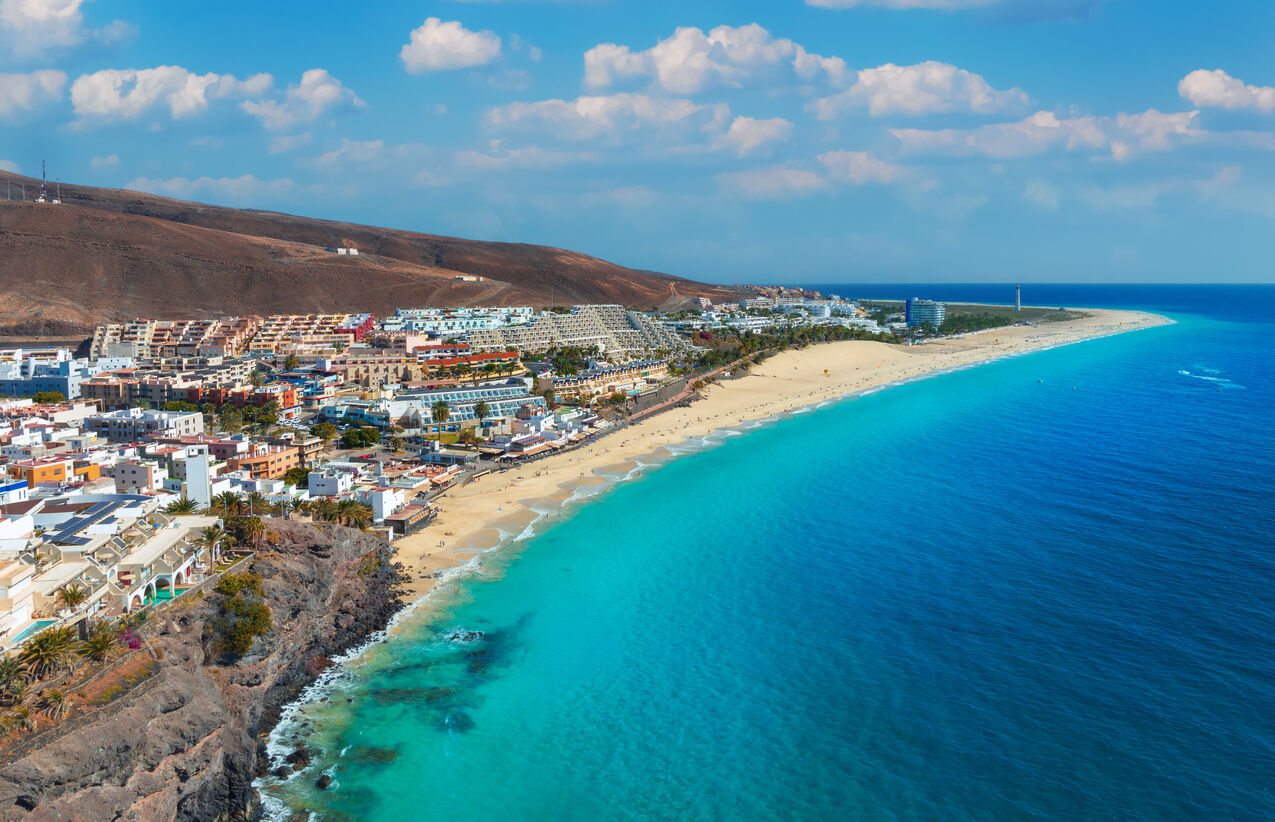
Fuerteventura
Weather
Local Information
Plug Socket Type
Type C/F (European two-pin). Irish visitors need a travel adapter.
Currency
Euro
Time Zones
GMT+0 (same as Ireland in winter, 1 hour behind in summer — Canary Islands are on GMT).
Local Emergency Contact
112 (general emergency). Irish Embassy Madrid: +34 914 364 093.
Travel Information
Flight Time
Approximately 4 hours from Dublin to Fuerteventura (FUE). Year-round flights.
Distance from Beach
All resorts are beachfront.
Do I need a Visa?
No. Spain is an EU member state. Irish citizens need only a valid passport or identity card.
3 Things to do in Fuerteventura
Corralejo Sand Dunes
–Vast natural park of golden dunes stretching along the coast — Fuerteventura's most spectacular landscape.
Lobos Island
–Tiny protected nature reserve off Corralejo with crystal-clear snorkelling and peaceful walking trails.
Betancuria
–Former capital in the mountainous interior — charming village with museum, church and goat cheese shops.
Description
Escape to Fuerteventura, the Canary Island renowned for its endless white sand beaches, turquoise waters, world-class windsurfing and kitesurfing, and a laid-back atmosphere perfect for a relaxing Irish holiday.
Fuerteventura is the Canary Island that beach lovers dream about. With over 150 kilometres of coastline — more than any other island in the archipelago — Fuerteventura boasts some of the most spectacular beaches in all of Europe. The vast golden dunes of Corralejo in the north, protected as a natural park, could easily be mistaken for the Sahara meeting the Atlantic, while the endless white sand beaches of Jandía and Costa Calma in the south offer kilometres of space even in peak season. The island has a wild, windswept character that sets it apart from the more developed Canary Islands — the interior is a dramatic landscape of volcanic mountains, ancient stone villages and free-roaming goats whose milk produces the award-winning Majorero cheese. Fuerteventura's reliable trade winds make it a world-class destination for windsurfing and kitesurfing, with international competitions held on its beaches. The main resort areas of Corralejo, Caleta de Fuste and Costa Calma are well equipped for Irish holidaymakers, with good restaurants, shops and entertainment. Direct flights from Dublin take around four and a half hours, and with year-round sunshine and the same time zone as Ireland, Fuerteventura is an ideal escape for beach-loving Irish families and couples.
Culture and Experiences
What's Nearby?
Lanzarote
– Ferry from Corralejo to Playa Blanca takes 25 minutes — easy day trip to a very different island.
Oasis Park
– Zoo and botanical garden in the south of the island with camel rides and animal shows.
Ajuy Sea Caves
– Dramatic black-sand beach and coastal caves on the west coast, reached by a short walk from the village.
History
Guanche Heritage
– The original Berber inhabitants left grain stores and rock inscriptions across the island.
Colonial Capital
– Betancuria was the first European colonial capital in the Canaries, founded in 1404.
Goat Cheese Tradition
– Majorero goat cheese holds DOP protected status — regularly winning international awards.
Local Markets
Corralejo Market
– Craft and produce market near the harbour.
La Oliva Market (Tuesday & Friday)
– Traditional market selling local produce, crafts and artisan goods.
Events and Festivals
Carnival (February-March)
– Colourful celebrations with Corralejo and Puerto del Rosario hosting the biggest parades.
Windsurfing World Cup (July)
– International competition on the beaches of Corralejo and Sotavento.
Fiestas Patronales
– Each town celebrates its patron saint with processions, music and feasting.
Local Etiquette
Wind
– Fuerteventura is the windiest Canary Island. Pack a light windbreaker.
Sun Protection
– The sun is strong year-round. High-factor sun cream is essential.
Tipping
– Small change or rounding up. 5-10% for good restaurant service.
Dining and Night Life
Local Cuisine
Majorero Cheese
– Fuerteventura's award-winning goat cheese — try it fresh, semi-cured or smoked.
Fresh Fish
– Vieja (parrotfish) is the island's favourite, served grilled with mojo.
Papas Arrugadas con Mojo
– Salt-crusted wrinkly potatoes with red and green mojo sauces.
Night Life
Corralejo
– The liveliest nightlife on Fuerteventura — main street bars and live music.
Caleta de Fuste
– Relaxed evening entertainment around the harbour.
Jandia
– Quiet resort area with hotel bars. Not a nightlife destination.

Read Time: 3 mins
Corralejo is Fuerteventura’s liveliest and most characterful resort, a genuine town at the northern tip of the island that combines a buzzing centre with world-class beaches and the spectacular Corralejo Natural Park sand dunes. Unlike many Canary Island resorts, Corralejo has a real town atmosphere with local shops, a harbour, traditional restaurants and a surf-culture vibe that gives it a youthful, energetic personality. For Irish visitors who want more than just a hotel and a beach, Corralejo delivers.
Location and Getting There
Corralejo is at the northern tip of Fuerteventura, approximately thirty minutes from Puerto del Rosario Airport (FUE). The flight from Dublin takes around four hours. The town faces the small island of Lobos and the larger Lanzarote across the strait — on clear days, the views across the water are magnificent. Ferry services to Lanzarote operate from Corralejo harbour, making day trips to the neighbouring island easy and affordable.
Beaches
The town beaches in Corralejo centre are small but pleasant, with calm water in the sheltered harbour area. The real prize lies just south of town, where the Corralejo Natural Park encompasses a vast system of golden sand dunes stretching for kilometres along the coast. These beaches — Playa del Moro, Playa del Pozo and others — are spectacularly beautiful: wide, golden, backed by dunes and washed by turquoise Atlantic water. They are accessible by car, bus or bicycle, and despite their popularity, their sheer scale means they never feel crowded. The Flag Beach area is a world-renowned kitesurfing and windsurfing spot.
The Canary Islands are volcanic in origin, which gives the coastline a distinctive character. Many beaches feature dark volcanic sand alongside imported golden sand, and the underwater landscape is rich with marine life, making snorkelling and diving rewarding activities.
Things to Do
Surfing, bodyboarding, windsurfing and kitesurfing are central to Corralejo’s identity, with multiple schools offering lessons for all levels. The waters around Lobos Island, a short ferry ride away, offer excellent snorkelling and diving in crystal-clear conditions. The Lobos island itself is a nature reserve perfect for a half-day walking excursion. Corralejo’s town centre is enjoyable to explore, with an old-town area of narrow streets, independent shops and cafes with character. The harbour hosts boat trips, fishing excursions and catamaran cruises. Acua Water Park provides family entertainment.
Dining and Nightlife
Corralejo has the best dining scene on Fuerteventura. The main street and harbour area are lined with restaurants offering everything from fresh fish and traditional Canarian tapas to global cuisine. Several restaurants in the old town are genuinely excellent and offer great value. The harbour is a particularly atmospheric spot for evening dining. Nightlife in Corralejo is lively by Fuerteventura standards — there are bars with live music, a handful of clubs and a generally sociable evening atmosphere centred on the main street.
Best Time to Visit
Fuerteventura’s warm, dry climate works year-round. Corralejo’s northern position means it catches more wind than the southern resorts, which is a plus for water sports but can be a factor on beach days. Sheltered spots within the dunes offer protection. Summer is warm in the high twenties, winter in the low twenties.
Practical Information for Irish Visitors
Fuerteventura is part of Spain and the EU. Euro currency, no visa. Canary Islands on GMT in winter. English widely spoken in Corralejo.
Healthcare in the Canary Islands is covered by the European Health Insurance Card (EHIC) for Irish citizens, though travel insurance is always recommended. Pharmacies (farmacias) are well stocked and pharmacists can advise on minor ailments without a doctor’s visit.
Why Book with Sunholidays.ie
Sunholidays.ie is Irish-owned and IAA licensed (Licence No. T0601). Twenty euro per person deposit, monthly payments, price match guarantee. The team knows Corralejo well and can match you with the right accommodation for your holiday style.

Read Time: 3 mins
Caleta de Fuste is Fuerteventura’s most convenient resort, purpose-built around a sheltered horseshoe bay on the eastern coast and just ten minutes from the airport. Its calm, family-friendly beach, compact layout and proximity to the island’s main commercial centre make it a practical and comfortable base. For Irish families with young children who value a short transfer and safe swimming conditions, Caleta de Fuste is a sensible and enjoyable choice.
Location and Getting There
Caleta de Fuste is on Fuerteventura’s east coast, just ten minutes south of Puerto del Rosario Airport (FUE) — giving it one of the shortest resort transfers in the Canary Islands. The flight from Dublin takes approximately four hours. The resort is well connected by road to the island’s other attractions, and the nearby town of Puerto del Rosario has supermarkets and local shops.
Beaches
The main beach at Caleta de Fuste occupies a man-made horseshoe bay that creates exceptionally calm, sheltered swimming conditions. The golden sand beach has full facilities and is overlooked by a promenade with cafes and restaurants. It is one of the most family-friendly beaches in the Canary Islands — the gentle slope, warm water and absence of currents make it ideal for young children. South of the resort, the beaches become more natural and less developed, offering quieter alternatives for those willing to drive a short distance.
Things to Do
The Fuerteventura Golf Club, an eighteen-hole course designed by links specialist Ron Kirby, is adjacent to the resort and offers year-round play at reasonable green fees. The Oceanarium Fuerteventura in the nearby El Castillo commercial centre is a family attraction. The salt museum at Las Salinas is an interesting visit. Caleta de Fuste’s central location makes it a good base for exploring the whole island — Corralejo and its dunes are forty minutes north, and Jandia is an hour to the south. Boat trips, diving and snorkelling can be arranged from the marina.
Dining and Nightlife
The resort has a reasonable selection of restaurants around the harbour, the main commercial centres and the hotel zone. Fresh fish, Canarian staples and international cuisine are all available. The harbour area is the most atmospheric dining location. Nightlife is gentle — hotel bars, a few pubs and occasional live music. This is not a party destination.
Best Time to Visit
Fuerteventura’s east coast is warm year-round. The sheltered bay at Caleta de Fuste is less affected by wind than the more exposed beaches elsewhere on the island, making it comfortable in all seasons. Summer highs in the high twenties, winter lows around twenty degrees.
Practical Information for Irish Visitors
Fuerteventura is part of Spain and the EU. Euro, no visa. Canary Islands on GMT in winter. English spoken in tourist areas.
Healthcare in the Canary Islands is covered by the European Health Insurance Card (EHIC) for Irish citizens, though travel insurance is always recommended. Pharmacies (farmacias) are well stocked and pharmacists can advise on minor ailments without a doctor’s visit.
Why Book with Sunholidays.ie
Sunholidays.ie is Irish-owned and IAA licensed (Licence No. T0601). Twenty euro per person deposit, monthly payments, price match guarantee. Perfect for families who want the shortest possible journey from airport to poolside.

Read Time: 5 mins
Jandia and Morro Jable sit at the southern tip of Fuerteventura, where the island narrows to a dramatic peninsula of mountains and beaches. This is where you will find some of the most spectacular stretches of sand in all of Europe — vast, wild beaches that seem to go on forever, backed by the rugged peaks of the Jandia Natural Park. Morro Jable, the main settlement, retains the character of a working fishing village alongside its tourism role. For Irish visitors seeking uncrowded beaches and natural beauty, this is Fuerteventura at its most impressive.
Location and Getting There
Jandia and Morro Jable are at the southern end of Fuerteventura, approximately one hour's drive from Puerto del Rosario Airport (FUE). The flight from Dublin takes around four hours. The drive south from the airport passes through increasingly dramatic desert landscapes before reaching the Jandia peninsula. Airport transfers are included in Sunholidays.ie packages.
Beaches
Playa de Jandia is one of Europe's great beaches — an unbroken ribbon of golden sand stretching for over twenty kilometres along the south-east coast of the peninsula. The beach is wide, the water is turquoise, and on most days you can walk for kilometres without encountering another person. Playa de Morro Jable, closer to the village, is more accessible and has full facilities including sunbeds, parasols and lifeguards. Playa de Butihondo between the two offers a midpoint option. The west coast of the peninsula, exposed to the Atlantic swell, has wilder conditions favoured by surfers and windsurfers.
The Canary Islands are volcanic in origin, which gives the coastline a distinctive character. Many beaches feature dark volcanic sand alongside imported golden sand, and the underwater landscape is rich with marine life, making snorkelling and diving rewarding activities. The Atlantic waters around the Canaries are home to sea turtles, rays, angel sharks and colourful tropical fish that have drifted north on warm currents from West Africa. Beach conditions vary throughout the day — mornings tend to be calmer, while afternoon trade winds can pick up, particularly on north and east-facing coasts.
Things to Do
The Jandia Natural Park covers the mountainous backbone of the peninsula and offers hiking opportunities with spectacular views over both coastlines. The Punta de Jandia lighthouse at the very tip of the island is a worthwhile drive through increasingly wild terrain. Boat trips from Morro Jable harbour include dolphin watching and excursions to hidden beaches. A fast ferry operates from Morro Jable to Las Palmas de Gran Canaria, making a day trip to the neighbouring island feasible. Surfing, windsurfing and kitesurfing are all available along the peninsula's beaches.
Beyond the resort attractions, the Canary Islands reward exploration. Each island has its own character and hidden corners — volcanic trails with views that stretch to neighbouring islands, traditional villages where local artisans produce pottery, cheese and wine using techniques passed down through generations, and nature reserves that protect unique flora and fauna found nowhere else on Earth. The islands are a designated UNESCO Biosphere Reserve, and walking trails crisscross the volcanic landscapes, from coastal paths to mountain summit routes. Many visitors find that hiring a car for a day or two opens up a completely different side of the island from the one visible at the resort.
Dining and Nightlife
Morro Jable's harbour area has excellent fish restaurants where the catch is landed fresh daily. The village centre has a selection of tapas bars, cafes and international restaurants. The restaurant scene is more authentically Canarian here than in the more touristic northern resorts. Nightlife is quiet — this is a destination for fresh-air days and early nights. A few bars offer live music and entertainment, but the atmosphere is relaxed and low-key.
The Canarian food tradition has its own identity, distinct from mainland Spain. Local wines, produced from volcanic soil in dramatic terraced vineyards, are increasingly gaining international recognition. Canarian cheeses — particularly the smoked goat cheeses of Fuerteventura and Gran Canaria — have won international awards. The mojo sauces, both red (spicy, made with peppers and paprika) and green (made with coriander or parsley), are the essential condiment and vary slightly from island to island. Gofio, a roasted grain flour of pre-Hispanic origin, is still used in traditional dishes. Dining out on the Canary Islands is generally excellent value — a full meal with wine at a local restaurant typically costs significantly less than the equivalent in Ireland.
Best Time to Visit
Fuerteventura's climate is warm and dry year-round. Summer temperatures reach the high twenties, winter stays in the low twenties. The beaches are magnificent in any season. Wind is a factor — the exposed west coast is windiest — but the sheltered east-facing beaches of Jandia are generally calm.
Practical Information for Irish Visitors
Fuerteventura is part of Spain and the EU. Euro currency, no visa. Canary Islands on GMT in winter. English spoken in tourist businesses.
Healthcare in the Canary Islands is covered by the European Health Insurance Card (EHIC) for Irish citizens, though travel insurance is always recommended. Tap water is safe but most visitors prefer bottled water, which is inexpensive and widely available. The islands have excellent road networks, and hire cars are affordable — driving is on the right-hand side. Pharmacies (farmacias) are well stocked and pharmacists can advise on minor ailments without a doctor's visit. The Canary Islands have no time difference with Ireland in winter, which is a real bonus — no jet lag on arrival and no adjustment needed for return.
Why Book with Sunholidays.ie
Sunholidays.ie is Irish-owned and IAA licensed (Licence No. T0601). Twenty euro per person deposit, monthly payments, price match guarantee. The team can help you decide between the various Fuerteventura resort areas for the right holiday experience.